Third Period (20 September – 31 December 1864)
The Third Period marks the consolidation of the Imperial Eagles issue throughout the Mexican postal system. By this time, district overprints and consignment numbers were firmly established, allowing stricter administrative control over stamp distribution and accounting.
Postal operations became more regular, and a greater variety of district markings, cancellations, and postal routes can be observed. Covers from this period illustrate the continued expansion of the Imperial postal network, from the principal district offices to numerous sub-offices across the Empire.
Although less transitional than the earlier periods, the Third Period provides valuable insight into the mature operation of the Imperial postal administration during the latter part of 1864.
Troisième Période (20 septembre – 31 décembre 1864)
La Troisième Période correspond à la phase de consolidation de l'émission des Aigles impériaux au sein du réseau postal mexicain. Les surcharges de district et les numéros d'envoi sont désormais pleinement établis, permettant un contrôle administratif plus rigoureux de la distribution et de l'utilisation des timbres.
Le fonctionnement des services postaux devient plus régulier et l'on observe une plus grande diversité d'oblitérations, de marques postales et de routes d'acheminement. Les plis de cette période illustrent l'expansion progressive du réseau postal impérial, depuis les bureaux principaux de district jusqu'aux nombreux sous-bureaux répartis à travers l'Empire.
Moins marquée par les changements que les périodes précédentes, la Troisième Période offre néanmoins un aperçu précieux du fonctionnement du système postal impérial à son apogée durant la fin de l'année 1864.
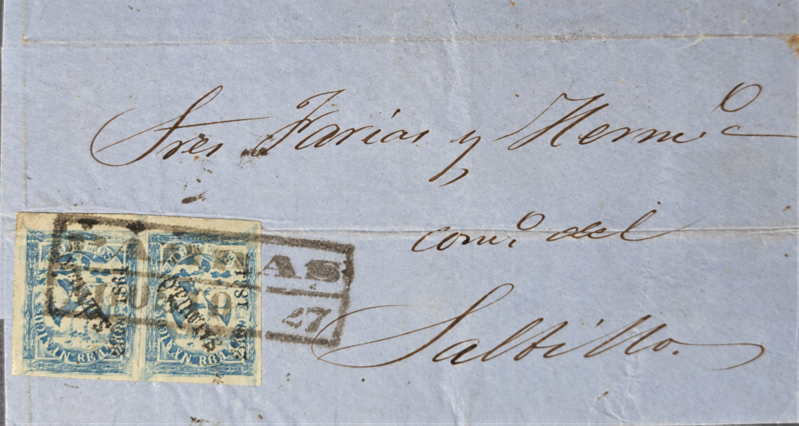
SUB-OFFICE PARRAS → SALTILLO – THIRD PERIOD
Cover sent from the Parras sub-office to Saltillo. It is franked with two blue 1 real Imperial Eagles, totalling 2 reales, bearing Third Period consignment 280–1864. The boxed Parras datestamp, showing the 27th, identifies the office of origin. The cover documents mail sent from a sub-office to the principal office of its postal district.
SOUS-BUREAU DE PARRAS → SALTILLO – TROISIÈME PÉRIODE
Lettre expédiée du sous-bureau de Parras à destination de Saltillo. Elle est affranchie de deux Aigles bleus à 1 real, soit 2 reales, portant la consignation 280–1864 de la troisième période. Le cachet encadré de Parras, daté du 27, identifie le bureau d’origine. Cette pièce montre la circulation d’une lettre entre un sous-bureau et le bureau principal de son district postal.
Main Post Offices / bureaux principaux and sub-office / sous-bureaux

JALAPA → PUEBLA, 1864
Letter franked with a 4 reales Eagle, Mexico district, consignment 185-1864, Third Period. The stamp is cancelled by an unusual administrative “4” handstamp reused as a postal cancellation, recorded as Schatzkès No. 606. According to Antonio Torres, approximately 100 examples of this cancellation are known. The 4 reales franking corresponds to the long-distance rate for a letter weighing between ¾ and 1 ounce (approximately 22.5–30 g).
JALAPA → PUEBLA, 1864
Lettre affranchie d’un Aigle de 4 reales, district de Mexico, consignation 185-1864, troisième période. Le timbre est annulé par un inhabituel cachet administratif « 4 », réemployé comme oblitération postale et répertorié sous le n° 606 de Schatzkès. Environ 100 exemplaires de cette oblitération sont connus. L’affranchissement à 4 reales correspond au tarif longue distance d’une lettre pesant entre ¾ et 1 once (environ 22,5 à 30 g).

SUB-OFFICE PATZCUARO → MORELIA
Cover franked with a 1 real blue stamp overprinted Morelia 221-1864, cancelled at the Pátzcuaro sub-office during the Third Period. An attractive example of Imperial Eagle usage in a secondary post office of the Morelia District during late 1864.
SOUS-BUREAU PATZCUARO → MORELIA
Lettre affranchie d’un 1 real bleu surchargé Morelia 221-1864, oblitéré du sous-bureau de Pátzcuaro durant la Troisième Période. Intéressant témoignage de l’utilisation des Aigles impériaux dans les localités secondaires du district de Morelia à la fin de l’année 1864.

MAIN POST OFFICE — DURANGO → MAZATLÁN
Cover franked with a 4 reales green stamp overprinted Durango 233-1864, addressed to Mazatlán via Guadalajara. An attractive Third Period usage illustrating the regular application of district overprints and consignment numbers.
BUREAU PRINCIPAL — DURANGO → MAZATLÁN
Lettre affranchie d’un 4 reales vert surchargé Durango 233-1864, adressée à Mazatlán via Guadalajara. Bel exemple d’utilisation d’un fort affranchissement durant la Troisième Période, alors que le système des surcharges de district et des numéros d’envoi est désormais pleinement établi.

MAIN POST OFFICE — PUEBLA → MEXICO
Cover franked at 5 reales with a combination of the 1 real blue and 4 reales green Imperial Eagle stamps. An attractive multiple-franking usage from the Third Period, illustrating the payment of a rate above the ordinary single-letter postage. Certificat MEPSI
BUREAU PRINCIPAL — PUEBLA → MEXICO
Lettre affranchie à 5 reales par une combinaison des valeurs 4 reales vert et 1 real bleu de l'émission des Aigles impériaux. Bel exemple d'affranchissement composé durant la Troisième Période, illustrant l'utilisation conjointe de plusieurs valeurs pour acquitter un tarif supérieur au port simple. Certificat MEPSI

SUB-OFFICE — SALAMANCA → GUANAJUATO
Cover franked with a 1 real blue stamp overprinted Guanajuato 121-1865, cancelled by the oval “Franco en Salamanca” handstamp. An attractive example of Imperial Eagle usage from the Salamanca sub-office within the Guanajuato District.
SOUS-BUREAU — SALAMANCA → GUANAJUATO
Lettre affranchie d’un 1 real bleu surchargé Guanajuato 121-1865, annulé par la marque ovale « Franco en Salamanca ». Témoignage de l’activité postale du sous-bureau de Salamanca au sein du district de Guanajuato durant l’année 1865.

SUB-OFFICE NAZAS TO DURANGO – 1864
Cover sent from Nazas to Durango, franked with a 2 reales yellow Imperial Eagle, Durango district, consignment 233-1864, Third Period.
Nazas was a sub-office of the Durango postal district. The stamp is cancelled by the distinctive linear NAZAS postmark, clearly struck across the stamp and extending onto the cover.
An attractive example of the use of the Imperial Eagle issue from a sub-office of the Durango district on domestic Mexican mail.
SOUS-BUEEAU NAZAS À DURANGO – 1864
Lettre expédiée de Nazas à Durango, affranchie d’un Aigle impérial de 2 reales jaune, district de Durango, envoi 233-1864, troisième période.
Nazas était un sous-bureau du district postal de Durango. Le timbre est oblitéré par le caractéristique cachet linéaire NAZAS, très nettement apposé sur le timbre et se prolongeant sur la lettre.
Un bel exemple de l’utilisation des Aigles impériaux au départ d’un sous-bureau du district de Durango sur le courrier intérieur mexicain.
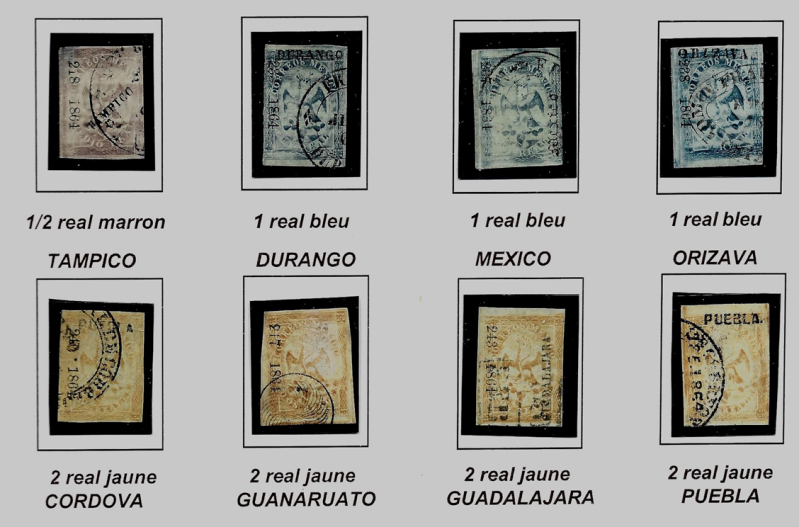
MAINS OFFICES
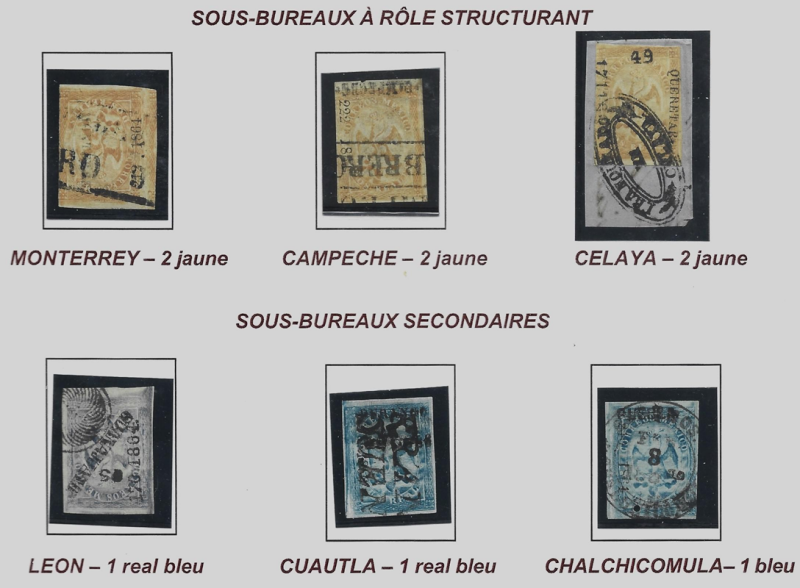
SUB-OFFICES / SOUS-BUREAUX