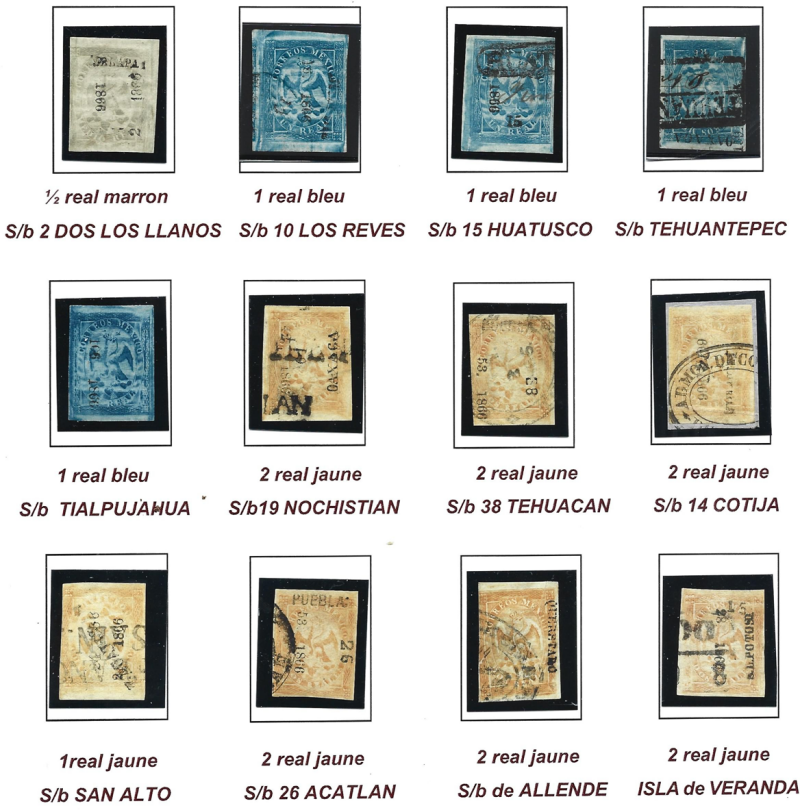
Sub-Post Offices During the Fifth Period (1 January – 31 July 1866)
The Fifth Period corresponds to the final months of use of the Imperial Eagle issue and the last years of the Second Mexican Empire. Despite an increasingly difficult political and military situation, the Imperial postal network continued to operate throughout most regions of the country.
Supplied by the principal district post offices, the sub-post offices played an essential role in the transmission of mail within the provinces. They served numerous small communities located far from the major administrative and commercial centres, ensuring the continuity of communications across the Empire.
The gradual withdrawal of French troops and the advance of Republican forces nevertheless caused increasing disruptions to communications and postal supplies in certain regions. Despite these difficulties, many sub-post offices continued to use Imperial Eagle stamps until the final months of the Empire.
Les sous-bureaux durant la Cinquième Période (1er janvier – 31 juillet 1866)
La Cinquième Période correspond aux derniers mois d'utilisation de l'émission des Aigles impériaux et aux dernières années du Second Empire mexicain. Malgré une situation politique et militaire de plus en plus difficile, le réseau postal impérial continua à fonctionner dans la plupart des régions du pays.
Les sous-bureaux, approvisionnés par les bureaux principaux de district, jouèrent un rôle essentiel dans l'acheminement du courrier au sein des provinces. Ils desservaient de nombreuses petites localités éloignées des grands centres administratifs et commerciaux, assurant ainsi la continuité des communications à travers le territoire impérial.
Le retrait progressif des troupes françaises et l'avancée des forces républicaines entraînèrent toutefois des perturbations croissantes des communications et de l'approvisionnement postal dans certaines régions. Malgré ces difficultés, de nombreux sous-bureaux continuèrent à utiliser les timbres des Aigles impériaux jusqu'aux derniers mois de l'Empire.

1866. LETTER FROM THE ALTATONGA SUB-OFFICE TO PUEBLA, 8 JUNE 1866
Franked with a 2 reales yellow Imperial Eagle stamp bearing the 69-1866 overprint, this cover was sent from the Altatonga sub-post office (Jalapa District) to Puebla.
It bears the oval “FRANQUEADO EN ALTATONGA” handstamp dated 8 June 1866, a characteristic marking used by sub-post offices to identify the origin of the mail. This cover illustrates the operation of the secondary postal network during the final months of the Second Mexican Empire.
1866. LETTRE DU SOUS-BUREAU D’ALTATONGA À PUEBLA, 8 JUIN 1866
Affranchie d'un 2 reales jaune de l'émission des Aigles impériaux, portant la surcharge 69-1866, cette lettre fut expédiée du sous-bureau d'Altatonga (district de Jalapa) à destination de Puebla.
Elle porte le cachet ovale « FRANQUEADO EN ALTATONGA » daté du 8 juin 1866, caractéristique des marques utilisées par les sous-bureaux pour identifier l'origine du courrier. Cette pièce illustre le fonctionnement du réseau postal secondaire durant les derniers mois du Second Empire mexicain.

1866. LETTER FROM HACIENDA DEL CARRO TO SAN LUIS POTOSÍ
Franked with a 1 real blue and a 2 reales yellow stamp of the Imperial Eagle issue, paying a total postage of 3 reales, this letter was sent from the Hacienda del Carro to San Luis Potosí.
The cover bears the striking rectangular “CARRO” handstamp, a postal marking associated with this important hacienda in the State of Zacatecas. Dated 19 December 1866 in the enclosed correspondence, it provides an interesting example of rural postal communications during the final months of the Second Mexican Empire.
Combining an attractive mixed franking with a distinctive hacienda marking, this cover illustrates the role played by large agricultural estates in the postal network of nineteenth-century Mexico.
1866. LETTRE DE L’HACIENDA DEL CARRO À SAN LUIS POTOSÍ, 19 DÉCEMBRE 1866
Affranchie d'un 1 real bleu et d'un 2 reales jaune de l'émission des Aigles impériaux, soit un affranchissement total de 3 reales, cette lettre fut expédiée de l'Hacienda del Carro à destination de San Luis Potosí.
Elle porte le remarquable cachet rectangulaire « CARRO », marque postale associée à cette importante hacienda de l'État de Zacatecas. Datée du 19 décembre 1866, elle constitue un intéressant témoignage du fonctionnement des communications postales rurales durant les derniers mois du Second Empire mexicain.

1866. COVER FRONT FROM THE MISANTLA SUB-OFFICE TO JALAPA
Franked with a 1 real blue and a 2 reales yellow stamp of the Imperial Eagle issue, paying a total postage of 3 reales, this front cover was sent from the Misantla sub-post office to Jalapa.
The district and consignment overprints visible on the stamps identify the correspondence as originating within the Jalapa District during the Fifth Period of the issue. Although only the front of the cover survives, it remains an interesting example of postal activity from a Veracruz sub-post office during the final months of the Second Mexican Empire.
Misantla was one of the principal regional centres in the northern part of the Jalapa District and maintained regular communications with the district capital.
1866. DEVANT DE LETTRE DU SOUS-BUREAU DE MISANTLA À JALAPA
Affranchi d'un 1 real bleu et d'un 2 reales jaune de l'émission des Aigles impériaux, soit un affranchissement total de 3 reales, ce devant de lettre fut expédié du sous-bureau de Misantla à destination de Jalapa.
La surcharge de district et de consignation visible sur les timbres permet de rattacher cette correspondance au district de Jalapa durant la Cinquième Période de l'émission. Bien qu'il ne subsiste que le devant de lettre, cette pièce constitue un intéressant témoignage de l'activité postale des sous-bureaux du Veracruz dans les derniers mois du Second Empire mexicain.
Misantla comptait parmi les principaux centres régionaux du nord du district de Jalapa et entretenait des échanges réguliers avec la capitale du district.
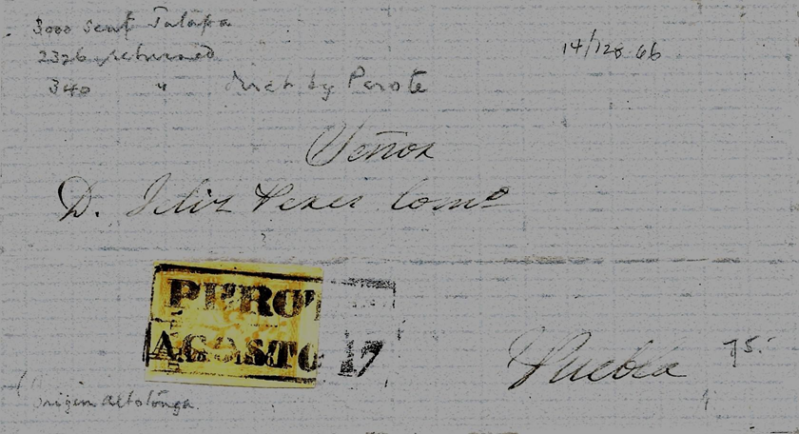
1866. COMPLETE LETTER FROM THE PEROTE SUB-OFFICE TO PUEBLA
Franked with a 2 reales yellow stamp of the Imperial Eagle issue, this complete letter was sent from the Perote sub-post office to Puebla.
It bears the remarkable “AGOSTO 17” dating marking used to record the mailing date at the sub-post office. According to Schatzkès, this represents a primitive type of dating mark employed by certain secondary offices that had not yet been supplied with a standardized datestamp.This marking provides valuable evidence of the methods used to process mail in the smaller offices of the Mexican Imperial postal system and illustrates the differences between the principal district offices and their subordinate post offices.
1866. LETTRE COMPLÈTE DU SOUS-BUREAU DE PEROTE À PUEBLA
Affranchie d'un 2 reales jaune de l'émission des Aigles impériaux, cette lettre complète fut expédiée du sous-bureau de Perote à destination de Puebla. Elle porte la remarquable marque de datation « AGOSTO 17 », utilisée pour dater le courrier au départ du sous-bureau. Selon Schatzkès, il s'agit d'un type primitif de datation employé par certains bureaux secondaires qui ne disposaient pas encore d'un cachet à date normalisé.
Cette marque constitue un précieux témoignage des méthodes de traitement du courrier dans les localités secondaires du Mexique impérial et illustre les différences existant entre les bureaux principaux de district et leurs sous-bureaux.