Fourth Period (1 January – 31 December 1865)
Quatrième Période (1er janvier – 31 décembre 1865)
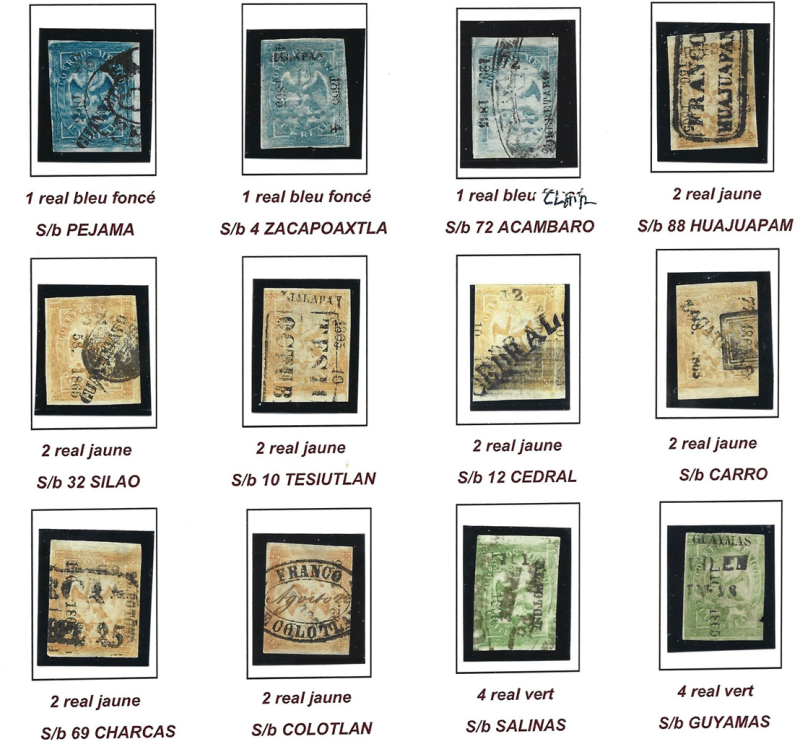
The year 1865 marks the peak of the postal system of the Second Mexican Empire. District overprints and consignment numbers were now applied systematically, while the network of principal post offices and sub-offices operated with increasing efficiency throughout the country.
This period is characterized by a relative abundance of covers and cancellations, a growing diversity of postal routes, and the appearance of more complex usages, both within Mexico and to foreign destinations. As such, it provides a particularly comprehensive view of the organization and operation of the Imperial postal administration under Emperor Maximilian.
L'année 1865 marque l'apogée du système postal du Second Empire mexicain. Les surcharges de district et les numéros d'envoi sont désormais appliqués de manière systématique, tandis que le réseau des bureaux principaux et des sous-bureaux fonctionne avec une grande régularité à travers le pays.
Cette période se caractérise par une abondance relative de plis et d'oblitérations, une diversité croissante des itinéraires postaux et l'apparition d'usages plus complexes, tant à l'intérieur du Mexique qu'à destination de l'étranger. Elle offre ainsi un aperçu particulièrement complet de l'organisation et du fonctionnement de l'administration postale impériale sous Maximilien.
Main Post Offices / bureaux principaux

PUEBLA → MADRID (SPAIN) 29 March – 1 May 1865
Mailed from Puebla on 29 March 1865 to Don Francisco Mendoza Cortina, one of Madrid's leading nineteenth-century bankers, this cover is franked with a 4 reales green Imperial Eagle stamp, overprinted PUEBLA.The stamp prepaid only the inland postage from Puebla to Veracruz, Mexico's principal port for overseas mail. The manuscript endorsement "Via Inglaterra" indicates that the cover was routed via Great Britain. After passing through London on 28 April 1865, it reached Madrid on 1 May 1865.
The red "4R" marking represents a Spanish postage due of four reales de vellón, collected from the recipient upon arrival.
A Remarkable ProvenanceThis cover originates from the celebrated Mendoza Cortina correspondence, one of the most important commercial archives of nineteenth-century Spain. Only a small portion of these archives survived their dispersal in the early 1980s. Acquired directly by Antonio Torres in 1984, the cover remained for more than forty years in his private "World Pearls" collection before joining the Patrice Mollien Collection.
Postal Route Puebla → Veracruz → London
Current Collection Patrice Mollien Collection
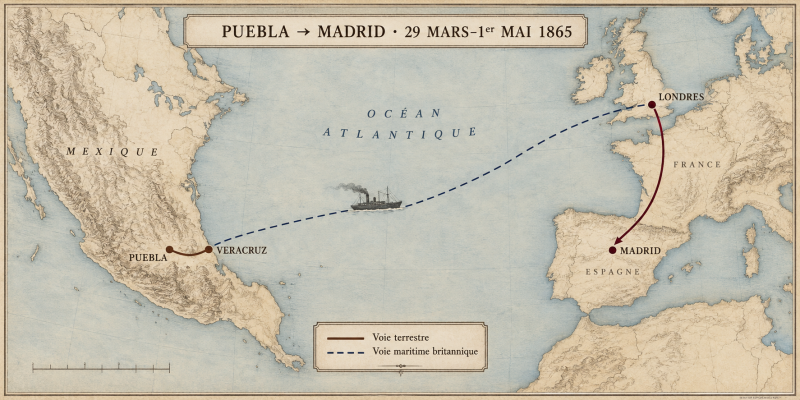
PUEBLA → MADRID (ESPAGNE)29 mars – 1er mai 1865 •
Expédiée de Puebla le 29 mars 1865 à destination de Don Francisco Mendoza Cortina, important banquier madrilène, cette lettre est affranchie d’un 4 reales vert des Aigles impériaux, surchargé PUEBLA.Le timbre acquittait uniquement le transport intérieur entre Puebla et Veracruz. La mention manuscrite « Via Inglaterra » indique un acheminement par la voie britannique. Après son transit par Londres le 28 avril 1865, la lettre parvint à Madrid le 1er mai.La marque rouge « 4R » correspond à une taxe espagnole de quatre reales de vellón, perçue auprès du destinataire.
Une provenance remarquable
Cette lettre provient des célèbres archives Mendoza Cortina, dont seule une faible partie fut préservée lors de leur dispersion au début des années 1980.Acquise directement par Antonio Torres en 1984, elle demeura plus de quarante ans dans sa collection privée « World Pearls », avant d’intégrer la collection Patrice Mollien.
Itinéraire postal Puebla → Veracruz → Londres → Madrid
Provenance Archives Mendoza Cortina - Ex Antonio Torres, “World Pearls”, London
Collection actuelle Patrice Mollien

MEXICO → GUADALAJARA, 12 MAY 1865
7 Reales Tricolour Franking. Complete cover sent from Mexico to Guadalajara on 12 May 1865, franked with a striking combination of the 1 real blue, 2 reales yellow and 4 reales green, paying a total postage of 7 reales. All three stamps bear the Mexico district overprint and their 1865 consignment numbers, characteristic features of the Fourth Period of the Imperial Eagles issue.
Tricolour frankings of this type are uncommon and illustrate the combined use of several denominations to pay a multiple-rate postage. An attractive example of postal operations under the Second Mexican Empire.
MEXICO → GUADALAJARA, 12 MAI 1865
Affranchissement tricolore de 7 reales. Lettre complète expédiée de Mexico à Guadalajara le 12 mai 1865, affranchie par une spectaculaire combinaison des valeurs de 1 real bleu, 2 reales jaune et 4 reales vert, soit un total de 7 reales.
Les trois timbres portent la surcharge de district « Mexico » ainsi que leur numéro d'envoi de 1865, caractéristiques de la quatrième période des Aigles impériaux.

GUANAJUATO → ITXASSOU (FRANCE)
29 June 1865 • Transatlantic Mail via the British Route
Cover sent from Guanajuato to Itxassou, in the French department of Basses-Pyrénées, franked with a 2 reales yellow Imperial Eagle bearing the Guanajuato district overprint and consignment number 58-1865. Cancelled at Guanajuato on 29 June 1865, the stamp prepaid the Mexican inland postage to the port of embarkation.
Forwarded to Veracruz, the letter was subsequently entrusted to the British maritime service for its Atlantic crossing. The boxed accountancy marking “GB / 1F60c” indicates the sum of 1 franc 60 centimes credited to the British postal administration in its accounts with France. It is a characteristic marking found on correspondence carried by the British route.
After reaching Great Britain, the letter was forwarded to France through Calais, as confirmed by the “ANGL. AMB. CALAIS” travelling post-office datestamp. It then continued overland to Itxassou, a small town in the French Basque Country. The various charge markings on the front indicate the settlement of the remaining international postage to be collected from the addressee.Certificate of the Royal Philatelic Society London.
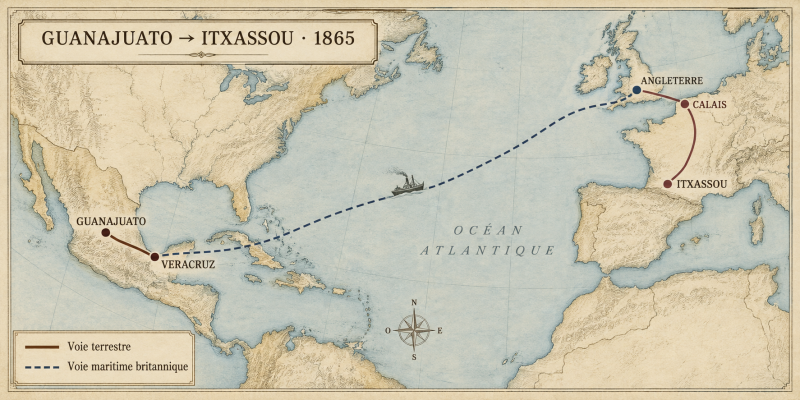
GUANAJUATO → ITXASSOU (FRANCE)
29 juin 1865 • Quatrième période • Courrier transatlantique par la voie britannique
Lettre expédiée de Guanajuato à destination d’Itxassou, dans les Basses-Pyrénées, affranchie d’un 2 reales jaune de l’émission des Aigles impériaux, portant la surcharge du district de Guanajuato et le numéro de consignation 58-1865. Le timbre, oblitéré à Guanajuato le 29 juin 1865, acquittait le transport intérieur mexicain jusqu’au port d’embarquement.
Acheminée vers Veracruz, la lettre fut ensuite confiée au service maritime britannique pour la traversée de l’Atlantique. La marque comptable encadrée « GB / 1F60c » indique la somme de 1 franc 60 centimes portée au crédit de l’administration britannique dans les comptes postaux avec la France. Elle constitue une marque caractéristique des correspondances acheminées par la voie anglaise.
Après son arrivée en Grande-Bretagne, la lettre fut dirigée vers la France par Calais, comme l’atteste le cachet ambulant « ANGL. AMB. CALAIS ». Elle poursuivit ensuite son parcours par voie terrestre jusqu’à Itxassou, petite commune du Pays basque français. Les différentes marques de taxation portées au recto témoignent du règlement du port international restant à percevoir auprès du destinataire. Certificat de la Royal Philatelic Society London.

ZACATECAS → DURANGO, OCTOBER 27, 18654
Entire commercial letter prepaid with a 2 reales orange Imperial Eagle stamp (Zacatecas District), cancelled by the FRANCO ZACATECAS handstamp of the Zacatecas Head Post Office. Addressed to Francisco Guerra in Durango, it illustrates the commercial exchanges between the States of Zacatecas and Durango during the Fourth Period of the Second Mexican Empire
ZACATECAS → DURANGO, 27 OCTOBRE 1865
Lettre commerciale entière affranchie d'un 2 reales orange de l'émission des Aigles impériaux (district de Zacatecas), oblitéré par le cachet FRANCO ZACATECAS du bureau principal de Zacatecas. Adressée à Francisco Guerra à Durango, elle illustre les échanges commerciaux entre les États de Zacatecas et de Durango durant la IVe période du Second Empire mexicain.

TULA → MEXICO
Cover franked with a 2 reales yellow Imperial Eagle stamp, cancelled by the straight-line “FRANCO” handstamp indicating prepaid postage. An attractive example of domestic mail from the Tula District during the Fourth Period.
TULA → MEXICO
Lettre affranchie d'un 2 reales jaune de l'émission des Aigles impériaux, oblitérée par la marque linéaire « FRANCO » indiquant le port payé. Bel exemple de courrier intérieur du district de Tula durant la Quatrième Période.

TOLUCA → SAN JUAN TEOTIHUACÁN
Cover franked with a 2 reales yellow stamp overprinted Toluca 53-1865, mailed from the Toluca District Post Office. The straight-line “FRANCO” marking indicates prepaid postage. An attractive Fourth Period usage from one of the principal post offices of the Imperial postal system.
TOLUCA → SAN JUAN TEOTIHUACÁN
Lettre affranchie d'un 2 reales jaune surchargé Toluca 53-1865, oblitéré du bureau principal de Toluca. La marque linéaire « FRANCO » indique le port payé. Bel exemple d'utilisation d'un timbre du district de Toluca durant la Quatrième Période.

GUANAJUATO–IRAPUATO
Cover franked with a horizontal pair of 1 real blue stamps overprinted Guanajuato, paying a total postage of 2 reales. An attractive multiple-franking usage from the Fourth Period, illustrating postal operations within the Guanajuato District during 1865.
GUANAJUATO–IRAPUATO
Lettre affranchie par une paire horizontale de 1 real bleu du district de Guanajuato, acquittant un port de 2 reales. Bel exemple d'utilisation d'un multiple sur lettre durant la Quatrième Période.

ORIZAVA → PUEBLA
Cover franked with a 2 reales yellow stamp overprinted Orizava 9-1865, one of the earliest consignment numbers recorded for the district in 1865. Cancelled by the oval “Administración de Correos de Orizava” handstamp, it illustrates postal communications between two principal offices of the Imperial postal network during the Fourth Period.
ORIZAVA → PUEBLA
Lettre affranchie d'un 2 reales jaune surchargé Orizava 9-1865, l'un des premiers numéros d'envoi de l'année 1865 pour ce district. Oblitérée par le cachet de l'Administración de Correos de Orizava, elle illustre les échanges postaux entre Orizava et Puebla sous le Second Empire mexicain.

VERA CRUZ → MEXICO CITY
Cover franked with a 2 reales yellow stamp overprinted 89-1865, cancelled by the circular “Franqueado Vera Cruz” handstamp. This prepaid marking is characteristic of the Vera Cruz Post Office, the principal gateway for international mail in Imperial Mexico. An attractive example of domestic correspondence during the Fourth Period.
VERA CRUZ → MEXICO CITY
Lettre affranchie d'un 2 reales jaune surchargé 89-1865, oblitérée par le cachet circulaire « Franqueado Vera Cruz ». Cette marque de port payé est caractéristique du principal bureau postal de Vera Cruz, principal port d'entrée et de sortie du courrier international du Mexique impérial. Bel exemple de courrier intérieur durant la Quatrième Période.