
MEXICO → NEW YORK, 30 October 1865 (4th Period)
Single-weight cover illustrating the Imperial Port Fee introduced by Maximilian for the Mexico–American Shipping Line.
This attractive cover was mailed from Mexico City to New York on 30 October 1865. It is franked with a 2 reales orange and a ½ real (7 centavos) from the Imperial Eagle issue, paying a total of 2½ reales.
The 2 reales prepaid the inland postage from Mexico City to Veracruz, while the ½ real did not represent additional postage. Instead, it paid the Imperial Port Fee, introduced by decree on 18 July 1865 to finance the transfer of outgoing mail from the Veracruz General Post Office directly to the steamship.
The manuscript endorsement "Vapor Mexico Americano New-York" shows that the sender specifically requested transportation by the Mexico-American Shipping Line, which connected Veracruz, Havana, and New York. This service was created to speed up communications between Mexico and the United States.
The large circular "STEAMSHIP 10" marking records the amount due from the addressee for the sea carriage and domestic delivery in the United States.
This cover is an outstanding example of one of the most specialized postal rates of the Second Mexican Empire. The Port Fee remained in use for only a short period, making surviving examples particularly desirable.
JEAN-CLAUDE PORIGNON COLLECTION
MEXICO → NEW YORK, 30 octobre 1865 (IVe période)
Lettre simple illustrant la taxe portuaire impériale instaurée par Maximilien pour la Mexico-American Shipping Line.
Cette remarquable lettre fut expédiée de Mexico à destination de New York le 30 octobre 1865. Elle est affranchie d'un 2 reales orange et d'un ½ real (7 centavos) de l'émission des Aigles impériaux, pour un affranchissement total de 2½ reales.
Le 2 reales acquitte le transport intérieur entre Mexico et Veracruz, tandis que le ½ real ne correspond pas à un supplément d'affranchissement. Il représente le paiement de la taxe portuaire impériale, créée par le décret du 18 juillet 1865 afin de couvrir le transfert du courrier entre le bureau principal de Veracruz et le paquebot amarré dans le port.
La mention manuscrite « Vapor Mexico Americano New-York » indique que l'expéditeur demanda expressément un acheminement par la Mexico-American Shipping Line, compagnie reliant Veracruz, La Havane et New York, afin de bénéficier d'un service plus rapide.
La grande marque circulaire « STEAMSHIP 10 » correspond au montant perçu auprès du destinataire pour le transport maritime et la distribution intérieure aux États-Unis.
Cette lettre constitue un remarquable témoignage de l'une des applications les plus spécialisées de l'émission des Aigles impériaux. La taxe portuaire ne fut appliquée que pendant une période relativement brève, ce qui rend les plis survivants particulièrement rares et recherchés.
JEAN-CLAUDE PORIGNON COLLECTION

MORELIA → LILLE (FRANCE), 29 November 1865
Entire letter sent from Morelia to Lille (France), franked with a ½ real lilac of the Imperial Eagle issue (Morelia consignment 143-1865), cancelled at Morelia and carried to France via Veracruz and the French packet service.
In April 1865, Emperor Maximilian introduced a special concessionary postal rate reducing the inland postage from 2 reales to ½ real for Belgian and Austrian volunteers serving in the Imperial Army. This measure applied to letters weighing less than half an ounce addressed to Europe.
The letter bears the French Consular handstamp "MEXIQUE 15 DEC 65", followed by the octagonal VERACRUZ PAQ. FR. B No. 4 datestamp of 16 December 1865, indicating transport aboard the French packet Nouveau Monde to Saint-Nazaire. Upon arrival in France, the letter was taxed 8 décimes, payable by the recipient.
According to the certificate issued by R. D. Jaretzky, this is the only recorded cover to France bearing the special ½ real concessionary rate, making it one of the most important postal history documents of the Imperial Eagle issue.
Source: J.C PORIGNON collection
MORELIA → LILLE (FRANCE), 29 novembre 1865
Lettre entière expédiée de Morelia à Lille (France), affranchie d'un ½ real lilas de l'émission des Aigles impériaux (consignation 143-1865 du district de Morelia), oblitéré à Morelia puis acheminé vers la France par Veracruz et la ligne postale française.
En avril 1865, l'empereur Maximilien instaura un tarif postal préférentiel réduisant l'affranchissement intérieur de 2 reales à ½ real pour les volontaires belges et autrichiens servant dans l'armée impériale. Cette mesure s'appliquait aux lettres de moins d'une demi-once destinées à l'Europe.
La lettre porte le cachet consulaire français "MEXIQUE 15 DEC 65", puis le cachet octogonal VERACRUZ PAQ. FR. B n° 4 du 16 décembre 1865, attestant son embarquement sur le paquebot français Nouveau Monde à destination de Saint-Nazaire. À son arrivée en France, elle fut taxée 8 décimes, acquittés par le destinataire.
Selon le certificat établi par R. D. Jaretzky, il s'agit de l'unique lettre connue à destination de la France bénéficiant de ce tarif préférentiel de ½ real, ce qui en fait l'un des plus importants témoignages d'histoire postale de l'émission des Aigles impériaux.
Source: J.C PORIGNON collection

MORELIA → BRUSSELS, May 1865
Official military correspondence of Baron Alfred van der Smissen, Commander of the Belgian Volunteer Corps, carried under the special ½ real military rate.
This exceptional cover was most likely mailed in May 1865 from the Morelia area by Baron Alfred van der Smissen, commander of the Belgian Volunteer Corps serving under Emperor Maximilian. It is addressed to Madame Van der Smissen in Brussels, where it arrived on 29 June 1865.
The cover is franked with a ½ real Hidalgo issue (consignment 220-1864, Morelia District). Although the normal domestic postage for such a letter would have been 2 reales, an Imperial decree issued by Maximilian in April 1865 granted Belgian and Austrian volunteers a special military rate of only ½ real, valid from their place of posting to the port of Veracruz.
From Veracruz, the letter was carried by British packet to London before continuing to Belgium. The reverse bears a London transit datestamp (28 June 1865), while the front shows several postal accounting marks recording the international charges collected during transit.
Particularly noteworthy is the provenance of the sender. Baron Alfred van der Smissen commanded the Belgian Volunteer Corps, one of the foreign contingents that supported Emperor Maximilian during the Second Mexican Empire. His correspondence is seldom encountered and represents an important testimony to the European military presence in Mexico.
JEAN-CLAUDE PRIGNON COLLECTION
MORELIA → BRUXELLES, mai 1865
Correspondance officielle du baron Alfred van der Smissen, commandant du Corps des volontaires belges, expédiée au tarif militaire spécial de ½ real.
Cette exceptionnelle lettre fut très probablement expédiée en mai 1865 depuis la région de Morelia par le baron Alfred van der Smissen, commandant du Corps des volontaires belges au service de l'empereur Maximilien. Elle est adressée à Madame Van der Smissen, à Bruxelles, où elle arriva le 29 juin 1865.
Elle est affranchie d'un ½ real de l'émission Hidalgo (consignation 220-1864, district de Morelia). Alors que le tarif postal normal aurait été de 2 reales, un décret impérial promulgué par Maximilien en avril 1865 accorda aux volontaires belges et autrichiens un tarif militaire préférentiel de seulement ½ real, valable entre le bureau d'origine et le port de Veracruz.
La lettre fut ensuite transportée par paquebot britannique jusqu'à Londres, avant de poursuivre son acheminement vers la Belgique. Le verso porte un cachet de transit de Londres (28 juin 1865), tandis que le recto présente plusieurs marques comptables internationales correspondant aux taxes et répartitions postales.
L'expéditeur confère à cette pièce un intérêt historique exceptionnel. Le baron Alfred van der Smissen, commandant du Corps des volontaires belges, joua un rôle majeur dans le soutien militaire apporté à Maximilien durant le Second Empire mexicain. Les correspondances provenant directement de ce haut responsable sont particulièrement rares et constituent des témoignages de premier ordre sur la présence européenne au Mexique.
JEAN-CLAUDE PRIGNON COLLECTION

PUEBLA → MADRID (SPAIN)
29 March – 1 May 1865
An Exceptional Cover to Spain
Mailed from Puebla on 29 March 1865 to Don Francisco Mendoza Cortina, one of Madrid's leading nineteenth-century bankers, this cover is franked with a 4 reales green Imperial Eagle stamp, overprinted PUEBLA.
The stamp prepaid only the inland postage from Puebla to Veracruz, Mexico's principal port for overseas mail. The manuscript endorsement "Via Inglaterra" indicates that the cover was routed via Great Britain. After passing through London on 28 April 1865, it reached Madrid on 1 May 1865.
The red "4R" marking represents a Spanish postage due of four reales de vellón, collected from the recipient upon arrival.
A Remarkable Provenance
This cover originates from the celebrated Mendoza Cortina correspondence, one of the most important commercial archives of nineteenth-century Spain. Only a small portion of these archives survived their dispersal in the early 1980s.
Acquired directly by Antonio Torres in 1984, the cover remained for more than forty years in his private "World Pearls" collection before joining the Patrice Mollien Collection.
Postal Route
Puebla → Veracruz → London → Madrid 29 March 1865 → 1 May 1865
Provenance : Mendoza Cortina Archives
Ex Antonio Torres – "World Pearls", London
Current Collection: Patrice Mollien Collection
PUEBLA → MADRID (ESPAGNE)
29 mars – 1er mai 1865 •
Une lettre exceptionnelle vers l’Espagne
Expédiée de Puebla le 29 mars 1865 à destination de Don Francisco Mendoza Cortina, important banquier madrilène, cette lettre est affranchie d’un 4 reales vert des Aigles impériaux, surchargé PUEBLA.
Le timbre acquittait uniquement le transport intérieur entre Puebla et Veracruz. La mention manuscrite « Via Inglaterra » indique un acheminement par la voie britannique. Après son transit par Londres le 28 avril 1865, la lettre parvint à Madrid le 1er mai.
La marque rouge « 4R » correspond à une taxe espagnole de quatre reales de vellón, perçue auprès du destinataire.
Une provenance remarquable
Cette lettre provient des célèbres archives Mendoza Cortina, dont seule une faible partie fut préservée lors de leur dispersion au début des années 1980.
Acquise directement par Antonio Torres en 1984, elle demeura plus de quarante ans dans sa collection privée « World Pearls », avant d’intégrer la collection Patrice Mollien.
Itinéraire postal
Puebla → Veracruz → Londres → Madrid
29 mars 1865 → 1er mai 1865
Provenance: Archives Mendoza Cortina
Ex Antonio Torres, “World Pearls”, London
Collection actuelle: Patrice Mollien

SALINAS – SAN LUIS POTOSÍ DISTRICT – 1865
Cover franked with a 2 reales yellow Imperial Eagle, San Luis Potosí district, consignment 139-1865, sub-consignment 83, Fourth Period.
The stamp was supplied to Salinas, a sub-office of the San Luis Potosí postal district, and is cancelled in manuscript.
This cover provides an interesting example of the distribution of Imperial Eagle stamps from the principal postal district to one of its sub-offices, identified by the additional sub-consignment number 83.
Certified piece illustrated from an eBay listing.
SALINAS – DISTRICT DE SAN LUIS POTOSÍ – 1865
Lettre affranchie d’un Aigle impérial de 2 reales jaune, district de San Luis Potosí, envoi 139-1865, sous-envoi 83, quatrième période.
Le timbre fut attribué à Salinas, sous-bureau du district postal de San Luis Potosí, et porte une oblitération manuscrite.
Cette lettre constitue un intéressant exemple de la distribution des timbres Aigle depuis le bureau principal du district vers l’un de ses sous-bureaux, identifié ici par le numéro de sous-envoi 83.
Pièce certifiée illustrée provenant d’une vente eBay.


The Mendoza Cortina Correspondence
Three Imperial Eagle Covers to Spain via Great Britain
These three covers, all addressed to Francisco Mendoza Cortina (or a close member of his family), illustrate the postal links between the Mexican Empire and Spain during the Imperial Eagle period.
Each letter bears a 4 reales green Imperial Eagle, the denomination used to prepay the inland Mexican postage from the office of origin to the port of Veracruz. From there, the mail travelled aboard British packet steamers to Europe before entering the Spanish postal system.
Although the route is essentially the same, the Spanish due markings differ:
-
Madrid: taxed 8 reales.
-
Madrid: taxed 4 reales.
-
Oviedo: taxed 4 reales.
These differences most likely reflect variations in postal assessment, letter weight, or the application of Spanish postal regulations rather than any difference in the Mexican postage paid.
Together, these covers provide an excellent illustration of the postal conventions linking the Imperial Mexican Post, the British Packet Service, and the Spanish Post Office during the Second Mexican Empire.
Rather than being viewed individually, they form a small but fascinating correspondence illustrating the complexity of transatlantic mail between Mexico and Spain.
Source: Schuyler J. Rumsey Philatelic Auctions, Sale 120, Lots 3353 and 3354; third cover from Mollien's collection.
La correspondance Mendoza Cortina
Trois lettres des Aigles impériaux acheminées vers l'Espagne via la Grande-Bretagne
Ces trois lettres appartiennent à la correspondance adressée à Francisco Mendoza Cortina, l'un des principaux destinataires espagnols de courrier en provenance du Mexique durant la période des Aigles impériaux.
Chacune est affranchie d'un 4 reales vert, destiné à acquitter le port intérieur mexicain jusqu'à Veracruz. Les lettres traversaient ensuite l'Atlantique à bord des paquebots britanniques, avant d'être remises à l'administration postale espagnole.
Les différentes taxes espagnoles (4R et 8R) témoignent du traitement postal appliqué à leur arrivée et illustrent la complexité des conventions postales anglo-espagnoles en vigueur sous le Second Empire mexicain.
Réunies, ces trois lettres constituent un remarquable témoignage des relations postales transatlantiques entre le Mexique et l'Espagne dans les années 1860.
Source: Schuyler J. Rumsey Philatelic Auctions, Sale 120, Lots 3353 and 3354; third cover from Mollien's collection.

Mexico–France Mixed Franking
Matamoros → Mexico City, March 22, 1868
An outstanding mixed-franking cover illustrating the combined use of the Mexican postal service and the French maritime packet service.
This entire letter was mailed from Matamoros to Mexico City on March 22, 1868. It bears a 2 reales orange Imperial Eagle stamp from the Fourth Period, consignment 135-1865, with the Matamoros district name applied in manuscript. The stamp is tied by the rare boxed Matamoros datestamp, Schatzkes 732.
The Mexican 2 reales stamp prepaid the internal Mexican postage before and after carriage by the French packet: from Matamoros to the packet service and, following disembarkation at Veracruz, overland to Mexico City.
The cover additionally bears an 80 centimes carmine Napoleon III stamp of France, cancelled by the French postal service and accompanied by the framed PD handstamp. The French stamp paid for carriage by French packet from Matamoros to Veracruz. The stamp has filing creases and a small tear at the bottom.
This remarkable combination documents the cooperation between the Mexican postal administration and the French maritime postal service. Used in March 1868, after the fall of the Second Mexican Empire, it also represents an exceptionally late use of an Imperial Eagle stamp.
A rare and highly desirable item of Franco-Mexican maritime postal history.
Estimate: US$7,500–10,000. Sold for US$19,000, excluding buyer’s premium.
Source: Schuyler J. Rumsey Philatelic Auctions, Sale 120, Lot 3342.
Matamoros → Mexico City, March 22, 1868
Remarquable lettre présentant un affranchissement mixte et illustrant l’utilisation conjointe de la poste mexicaine et du service maritime français.
Cette lettre entière fut expédiée de Matamoros à destination de Mexico le 22 mars 1868. Elle porte un timbre Aigle impérial de 2 reales orange de la quatrième période, consignation 135-1865, avec le nom du district de Matamoros inscrit à la main. Le timbre est oblitéré par le rare cachet rectangulaire de Matamoros, référencé Schatzkès 732.
Le timbre mexicain de 2 reales acquittait le port intérieur mexicain avant et après le transport par le paquebot français : d’abord à Matamoros, puis, après le débarquement à Veracruz, pour l’acheminement terrestre jusqu’à Mexico.
La lettre porte également un 80 centimes carmin Napoléon III, oblitéré par le service postal français et accompagné de la marque encadrée PD. Ce timbre français acquittait le transport maritime par paquebot français entre Matamoros et Veracruz. Il présente des plis d’archive ainsi qu’une petite déchirure dans sa partie inférieure.
Cette association remarquable témoigne de la coopération entre l’administration postale mexicaine et le service maritime français. Utilisée en mars 1868, après la chute du Second Empire mexicain, cette lettre constitue également une utilisation exceptionnellement tardive d’un timbre Aigle impérial.
Une pièce rare et particulièrement recherchée de l’histoire postale maritime franco-mexicaine.
Source : Schuyler J. Rumsey Philatelic Auctions – Sale 120, lot 3342.
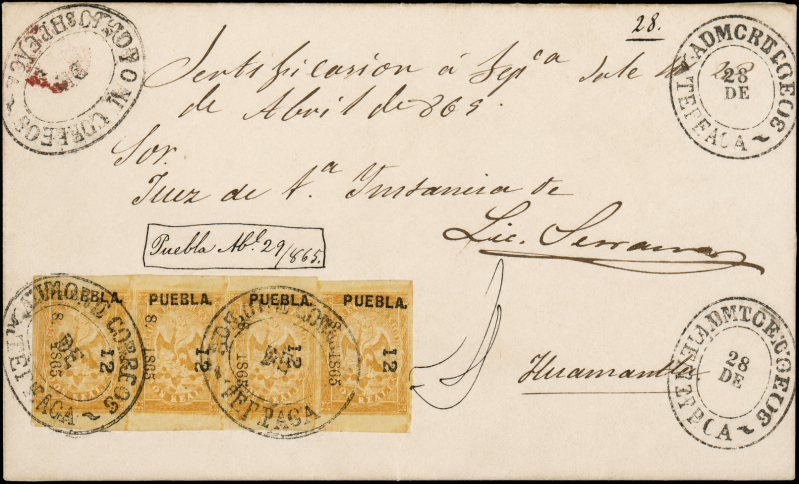
PUEBLA (Sub-office No. 12 – Huamantla) → MONTEVIDEO (URUGUAY), 29 April 1865
Strip of four 2 reales orange – Fourth Period – Consignment 8-1865
Entire commercial letter mailed from the Puebla District, originating from the sub-office of Huamantla (Sub-office No. 12), to Montevideo, Uruguay, on 29 April 1865. The cover is franked with a spectacular strip of four 2 reales orange stamps of the Imperial Eagle issue, Fourth Period (Consignment 8-1865), paying a total postage of 8 reales.
The stamps bear the Puebla district overprint and the sub-office number "12", identifying Huamantla as the office to which this consignment was assigned. They are tied by clear PUEBLA CORREOS circular datestamps, while Montevideo arrival markings on the front document the successful transmission of the letter to Uruguay.
This cover is particularly attractive because of its multiple franking in a strip of four, a scarce and visually striking usage on an overseas destination. It illustrates the international postal connections maintained by the Mexican Imperial Post with South America during the Second Empire.
The combination of a complete commercial cover, a high-value 8 reales franking, an overseas destination and stamps assigned to a Puebla District sub-office makes this an outstanding example of the postal history of the Imperial Eagle issue.
Source: Jean-Claude Polignon Collection.
PUEBLA (Sous-bureau n° 12 – Huamantla) → MONTEVIDEO (URUGUAY), 29 avril 1865
Bande de quatre timbres de 2 reales orange – IVe période – Consignation 8-1865
Lettre commerciale entière expédiée du district de Puebla, provenant du sous-bureau de Huamantla (sous-bureau n° 12), à destination de Montevideo (Uruguay), le 29 avril 1865. Elle est affranchie d'une spectaculaire bande de quatre timbres de 2 reales orange de l'émission des Aigles impériaux, IVe période (consignation 8-1865), représentant un affranchissement total de 8 reales.
Les timbres portent la surcharge du district de Puebla ainsi que le numéro de sous-bureau « 12 », identifiant Huamantla comme bureau destinataire de cette consignation. Ils sont oblitérés par de nets cachets circulaires PUEBLA CORREOS, tandis que les cachets d'arrivée de Montevideo apposés au recto attestent l'acheminement de la lettre jusqu'en Uruguay.
Cette pièce est particulièrement remarquable par son affranchissement multiple en bande de quatre, un usage peu courant et très esthétique sur une destination d'outre-mer. Elle illustre les relations postales internationales entretenues entre le Mexique impérial et l'Amérique du Sud durant le Second Empire.
L'association d'une lettre commerciale complète, d'un affranchissement élevé de 8 reales, d'une destination internationale et de timbres attribués à un sous-bureau du district de Puebla fait de cette pièce un remarquable témoignage de l'histoire postale des Aigles impériaux.
Source : Collection Jean-Claude Polignon.

Merida District → Maxkukul, 1865 (4th Period)
Unique Horizontal Bisect Between Two Tiny Yucatán Post Offices
Among the greatest rarities of the Imperial Eagle issue, this remarkable folded letter bears a horizontal bisect of the 2 reales orange from the Fourth Period, cancelled by the rare brown dotted oval "Franco Citas" handstamp (Schatzkes 790F), distinguished by its reversed letter "C".
The surviving half stamp retains the lower portion of the original 1865 consignment number, further confirming its authenticity and postal origin.
The true importance of this cover, however, lies in its extraordinary postal history. It represents the only recorded correspondence between the two small post offices of the Merida District and Maxkukul, making it not only an exceptional bisect but also a unique witness to the postal communications of the Yucatán Peninsula during the reign of Emperor Maximilian.
Bisected Eagle stamps are among the most sought-after specialties of Mexican philately, but examples combining a rare cancellation, a documented consignment, and a unique postal route are virtually impossible to duplicate.
Although the cover shows light overall toning and reinforcement at the folds, these minor condition issues are insignificant when compared with its exceptional rarity and historical importance.
A major exhibition piece and one of the finest known postal history items of the Imperial Eagle issue.
More than a rare bisect, this cover preserves the only recorded postal communication between two tiny Yucatán post offices during the Imperial period.
Source: Schuyler J. Rumsey Philatelic Auctions – Sale 120, Lot 3352.
District de Mérida → Maxkukul, 1865 (IVe période)
Exceptionnel bisect horizontal entre deux minuscules bureaux du Yucatán
Cette remarquable lettre repliée est affranchie d'un bisect horizontal du 2 reales orange de la Quatrième période, oblitéré par le rare cachet ovale pointillé brun « Franco Citas » (Schatzkes 790F), facilement identifiable par sa lettre « C » inversée.
Le demi-timbre conserve la partie inférieure du numéro d'envoi 1865, élément particulièrement recherché qui confirme son origine postale.
L'importance de cette pièce dépasse largement le simple usage d'un bisect. Elle constitue l'unique correspondance actuellement répertoriée entre ces deux minuscules bureaux du district de Mérida et de Maxkukul, ce qui en fait un document postal d'une importance exceptionnelle pour l'étude des communications dans le Yucatán sous le Second Empire mexicain.
Les bisects des Aigles impériaux figurent parmi les spécialités les plus prestigieuses de la philatélie mexicaine. Réunir sur une même lettre un bisect authentique, un cachet rare de sous-bureau, une partie du numéro d'envoi et une relation postale unique constitue une combinaison d'une rareté extraordinaire.
Malgré une légère oxydation générale du papier et quelques renforcements anciens des plis, ces défauts demeurent secondaires au regard du caractère exceptionnel et irremplaçable de cette pièce.
Une véritable pièce de musée, illustrant à la fois la rareté des affranchissements fractionnés et l'extrême difficulté des communications postales dans les régions les plus isolées du Yucatán impérial.
Bien plus qu'un simple bisect, cette lettre constitue le seul témoignage postal actuellement répertorié entre deux minuscules bureaux du Yucatán durant le Second Empire mexicain.
Source: Schuyler J. Rumsey Philatelic Auctions – Sale 120, Lot 3352.

MEXICO → VAUX (FRANCE), 1865
Double-weight cover carried by the French Packet Line
Sent from Mexico to Vaux, France, this attractive folded letter is franked with a 4 reales green of the Fourth Period (consignment 198-1865), tied by the Mexico circular datestamp. The cover travelled aboard a French packet steamer, receiving on arrival the octagonal maritime datestamp "1 MEXIQUE 1", while the reverse bears the "Vera-Cruz / Paq. Fr. B. No. 4" packet marking.
The red manuscript "2" indicates that the letter was carried at double weight, resulting in a substantial postage due of 16 décimes, collected upon delivery in France.
Combining a Fourth Period Imperial Eagle, French maritime postal markings and international taxation, this cover illustrates the operation of the postal conventions linking Mexico and France during the Second Mexican Empire. Such examples are scarce and highly desirable for collections devoted to Mexican overseas mail.
Source: Schuyler Rumsey Philatelic Auctions, Sale 120, Lot 3355.
MEXICO → VAUX (FRANCE), 1865
Lettre à double poids transportée par la Ligne des Paquebots français
Cette lettre entière expédiée de Mexico à Vaux (France) est affranchie d'un 4 reales vert de la IVe période (consignation 198-1865), oblitéré par le cachet circulaire de Mexico. Acheminée par paquebot français, elle reçoit à son arrivée le cachet maritime octogonal « 1 MEXIQUE 1 », tandis que le verso porte le cachet « Vera-Cruz / Paq. Fr. B. No. 4 ».
La mention manuscrite rouge « 2 » indique que la lettre circulait au double poids, ce qui entraîna une taxation importante de 16 décimes, perçue à l'arrivée en France.
Réunissant un timbre de la IVe période des Aigles impériaux, des marques postales maritimes françaises et une taxation internationale parfaitement documentée, cette lettre illustre le fonctionnement des échanges postaux entre le Mexique et la France sous le Second Empire mexicain. Les plis de cette qualité sont rares et particulièrement recherchés pour les collections consacrées au courrier international du Mexique.
Source : Schuyler Rumsey Philatelic Auctions, Sale 120, Lot 3355.

ZAPOTLÁN → GUADALAJARA, 17 March 1865
Vertical bisect of the 4 reales green – Fourth Period
Entire commercial letter sent from Zapotlán to Guadalajara on 17 March 1865, franked with a vertical bisect of the 4 reales green of the Imperial Eagle issue (Fourth Period, consignment 24-1865). The bisect is tied by the Zapotlán cancellation and represents one of the scarcer provisional usages of the Imperial Eagle series.
The cover was repaired, but it remains an attractive and scarce example of a bisected Eagle stamp used on a complete commercial cover. The stamp displays a clear margin at left and is accompanied by a MEPSI certificate.
Source: Spink, The "KMC" Collection of Mexico, Sale 24033, Lot 156
ZAPOTLÁN → GUADALAJARA, 17 mars 1865
Demi 4 reales vert coupé verticalement – IVe période
Lettre commerciale entière expédiée de Zapotlán à Guadalajara le 17 mars 1865, affranchie d'un 4 reales vert de l'émission des Aigles impériaux coupé verticalement (IVe période, envoi 24-1865). Le demi-timbre, oblitéré à Zapotlán, constitue un remarquable exemple d'utilisation provisoire des Aigles impériaux.
Bien que la lettre ait été restaurée, elle demeure une pièce rare et particulièrement intéressante, les bissections authentiques sur lettre étant peu communes. Le timbre présente une belle marge à gauche et la pièce est accompagnée d'un certificat MEPSI.
Source :Spink, The "KMC" Collection of Mexico, vente 24033, lot 156.

NAZAS → DURANGO, 1865
A Rare Mixed Franking from the Nazas Sub-office
This attractive folded letter, mailed in 1866, bears a rare mixed franking consisting of a 4 reales green and two 1 real blue Imperial Eagle stamps, all from the Durango District. The adhesives are tied by two bold strikes of the straight-line NAZAS handstamp, one of the most desirable sub-office cancellations of the Imperial Eagle issue.
The cover illustrates postal operations at the small Nazas sub-office, where only limited quantities of stamps were distributed. According to the consignments recorded for this office, only 100 examples of the 4 reales and 200 examples of the 1 real from the relevant consignments reached Nazas, making surviving postal history from this office exceptionally scarce.
Beyond its rarity, the cover demonstrates the practical use of a mixed denomination franking, combining different face values to satisfy the required postal rate. Such combinations provide valuable insight into the postal accounting practices of the Mexican Imperial Post during the Fourth Period.
For collectors specializing in the Imperial Eagle issue, this cover is particularly desirable because it combines a rare sub-office cancellation, limited stamp consignments and an attractive multicolour franking.
Source: Schuyler J. Rumsey Philatelic Auctions – Sale 329, Lot 571.
NAZAS → DURANGO, 1866
Un rare affranchissement mixte du sous-bureau de Nazas
Cette remarquable lettre repliée, expédiée en 1866, est affranchie d'un 4 reales vert associé à deux timbres de 1 real bleu de l'émission des Aigles impériaux du district de Durango. Les trois timbres sont oblitérés par deux frappes nettes du cachet linéaire NAZAS, l'une des marques de sous-bureau les plus recherchées de cette émission.
Cette pièce illustre le fonctionnement postal du petit sous-bureau de Nazas, où les quantités de timbres mises à disposition étaient extrêmement limitées. D'après les registres de consignation, seuls 100 exemplaires du 4 reales et 200 exemplaires du 1 real des consignations concernées furent distribués à Nazas, ce qui explique la très grande rareté des plis provenant de ce bureau.
Au-delà de sa rareté, cette lettre constitue un remarquable exemple d'affranchissement mixte, combinant plusieurs valeurs faciales afin d'acquitter le tarif postal requis. Ces combinaisons témoignent des pratiques tarifaires et comptables de l'administration postale du Second Empire mexicain pendant la Quatrième période.
Pour les spécialistes des Aigles impériaux, cette lettre réunit plusieurs qualités rarement associées : un cachet de sous-bureau emblématique, des timbres provenant de consignations très limitées et un affranchissement particulièrement harmonieux.
Source : Schuyler J. Rumsey Philatelic Auctions – Sale 329, Lot 571.

MORELIA → CELAYA, 14 August 1865
Exceptional combination of the 2 reales and 4 reales from the Morelia consignment
English
Entire commercial letter sent from Morelia to Celaya on 14 August 1865, franked with a 2 reales orange and a 4 reales green from the Imperial Eagle issue (Fourth Period, consignment 77-1865). Both stamps are tied by clear double-circle MORELIA cancellations.
This cover is particularly significant because of the exceptionally small quantities supplied to the district of Morelia for direct postal use. Only 187 examples of the 2 reales and 486 examples of the 4 reales were dispatched in consignment 77-1865, making this one of the rarest Fourth Period combinations on a complete commercial cover.
Both stamps retain clear to large margins, with only one side of the 4 reales slightly touched. The freshness of the cover further enhances its attractiveness.
Accompanied by a 2024 MEPSI certificate.
Provenance: The Leo V. Corbett Collection.
MORELIA → CELAYA, 14 août 1865
Exceptionnelle combinaison des 2 reales et 4 reales du contingent de Morelia
Français
Lettre commerciale entière expédiée de Morelia à Celaya le 14 août 1865, affranchie d'un 2 reales orange et d'un 4 reales vert de l'émission des Aigles impériaux (IVe période, envoi 77-1865). Les deux timbres sont oblitérés par de nets cachets circulaires de Morelia.
Cette lettre est particulièrement remarquable en raison du très faible nombre de timbres expédiés au district de Morelia pour cette émission. Le contingent 77-1865 ne comprenait que 187 exemplaires du 2 reales et 486 exemplaires du 4 reales, ce qui confère à cette combinaison sur lettre commerciale complète une rareté exceptionnelle.
Les deux timbres présentent de belles marges, seule une marge du 4 reales étant légèrement touchée. La remarquable fraîcheur de la lettre renforce encore son intérêt philatélique.
Accompagnée d'un certificat MEPSI (2024).
Provenance : Collection Leo V. Corbett.

LA PIEDAD → GUADALAJARA, 15 August 1865
Exceptional 8 reales usage from the La Piedad sub-office
Entire letter sent from the La Piedad sub-office to Guadalajara on 15 August 1865, franked on the reverse with an 8 reales red of the Imperial Eagle issue, Fourth Period, consignment 84-1865, sub-office 5. The stamp, with clear to ample margins, is cancelled by the large FRANCO EN LA PIEDAD handstamp.
Only ten examples of the 8 reales were supplied for use at this sub-office. This cover is therefore most likely the only recorded complete letter bearing this value from La Piedad.
Covers franked with the 8 reales, the highest denomination of the Imperial Eagle issue, are exceptionally scarce. An example originating from a sub-office and surviving on a complete commercial letter represents a major rarity of Mexican postal history.
Accompanied by a 2024 MEPSI certificate.
Source: Spink, Sale 24033, Lot 186.
LA PIEDAD → GUADALAJARA, 15 août 1865
Exceptionnel emploi du 8 reales au sous-bureau de La Piedad
Lettre entière expédiée du sous-bureau de La Piedad à destination de Guadalajara le 15 août 1865, affranchie au verso d’un 8 reales rouge de l’émission des Aigles impériaux, IVe période, envoi 84-1865, sous-bureau n° 5. Le timbre, présentant des marges nettes à généreuses, est oblitéré par le grand cachet FRANCO EN LA PIEDAD.
Seulement dix exemplaires du 8 reales furent attribués à ce sous-bureau. Cette pièce est donc très probablement l’unique lettre complète connue portant cette valeur au départ de La Piedad.
Les lettres affranchies avec le 8 reales, valeur la plus élevée de l’émission des Aigles impériaux, sont exceptionnellement rares. Un tel affranchissement provenant d’un sous-bureau et conservé sur une lettre commerciale entière constitue une rareté majeure de l’histoire postale mexicaine.
Accompagnée d’un certificat MEPSI de 2024.
Source : Spink, vente 24033, lot 186.

TEPETZINTLÁN → MEXICO, 1 February 1865
4 reales green – Fourth Period (Consignment 75-1865) – Puebla District, Sub-office No. 14
Entire commercial letter sent from the Tepetzintlán sub-office (Puebla District, Sub-office No. 14) to Mexico City on 1 February 1865, franked with a 4 reales green of the Imperial Eagle issue, Fourth Period (Consignment 75-1865).
The stamp is cancelled by the bold FRANCO EN TEPETZINTLÁN straight-line handstamp, one of the distinctive postal markings used by the Puebla district sub-offices. The cancellation is exceptionally well struck and clearly identifies the office of origin.
This cover illustrates the operation of the Imperial postal network through a rural sub-office during the Fourth Period. Mail from Tepetzintlán was collected locally before entering the main postal routes leading to the capital.
The stamp displays four clear margins and is well centred on a clean commercial cover, making this an attractive example of a sub-office usage from the Puebla District.
Source: Spink, Sale 24033, Lot 194.
TEPETZINTLÁN → MEXICO, 1er février 1865
4 reales vert – IVe période (Consignation 75-1865) – District de Puebla, sous-bureau n° 14
Lettre commerciale entière expédiée du sous-bureau de Tepetzintlán (district de Puebla, sous-bureau n° 14) à destination de Mexico le 1er février 1865, affranchie d'un 4 reales vert de l'émission des Aigles impériaux, IVe période (consignation 75-1865).
Le timbre est oblitéré par le cachet linéaire FRANCO EN TEPETZINTLÁN, l'une des marques postales caractéristiques utilisées par les sous-bureaux du district de Puebla. Cette oblitération, particulièrement nette et bien frappée, identifie clairement le bureau d'origine.
Cette lettre illustre le fonctionnement du réseau postal impérial à partir d'un sous-bureau rural durant la IVe période. Le courrier était recueilli à Tepetzintlán avant d'être acheminé vers les principaux axes postaux conduisant à la capitale.
Le timbre présente quatre marges complètes et est apposé sur une lettre commerciale en excellent état de conservation, constituant un remarquable exemple d'utilisation d'un timbre des Aigles impériaux par un sous-bureau du district de Puebla.
Source : Spink, vente 24033, lot 194.

MATAMOROS → NEW ORLEANS (USA)
12 April 1865 – Fourth Period
A Great Rarity from the Matamoros District
This cover was mailed from Matamoros to New Orleans, Louisiana, on 12 April 1865. It is franked with a 1 real blue of the Imperial Eagle Issue, from Consignment 135-1865, cancelled by the boxed "H. MATAMOROS / ABRIL 12" datestamp.
According to published postal records, only a very small number of Imperial Eagle covers from the Matamoros district are known. This cover represents the only recorded example bearing the 1 real blue of this district on cover.
The addressee's name was deliberately removed. According to Rumsey Philatelic Auctions, this may have been done to prevent the recipient from being identified by Union authorities in New Orleans during the closing months of the American Civil War.
This remarkable cover is illustrated in Karl H. Pietsch, The Imperial Eagles of Mexico 1864–1866 (page 199).
Documentary Source
Schuyler J. Rumsey Philatelic Auctions
Sale 75 – Lot 2324
MATAMOROS → LA NOUVELLE-ORLÉANS (ÉTATS-UNIS)
12 avril 1865 – Quatrième période
Une grande rareté du district de Matamoros
Cette lettre a été expédiée de Matamoros à destination de La Nouvelle-Orléans le 12 avril 1865. Elle est affranchie d'un 1 real bleu de l'émission des Aigles impériaux, provenant de l'envoi 135-1865, oblitéré par le cachet rectangulaire « H. MATAMOROS / ABRIL 12 ».
Selon les archives postales et les recherches publiées, seuls quelques usages sur lettre des timbres des Aigles impériaux du district de Matamoros sont aujourd'hui connus. Cette pièce constitue le seul exemple recensé d'une lettre affranchie avec le 1 real bleu de ce district.
Le nom du destinataire a été volontairement supprimé. Selon l'hypothèse avancée par la maison Rumsey Philatelic Auctions, cette modification pourrait avoir été réalisée afin d'éviter l'identification du correspondant par les forces de l'Union présentes à La Nouvelle-Orléans à la fin de la guerre de Sécession.
Cette lettre est reproduite dans l'ouvrage de Karl H. Pietsch, The Imperial Eagles of Mexico 1864–1866 (page 199).
Provenance documentaire
Schuyler J. Rumsey Philatelic Auctions
Sale 75 – Lot 2324


MAZATLÁN → GUADALAJARA
1865 • Fourth Period
A Very Rare Printed Matter Rate Usage
This printed commercial circular was mailed from Mazatlán to Guadalajara in 1865. It is franked with a ½ real lilac Imperial Eagle stamp, overprinted MAZATLÁN (Consignment 191-1865).
The stamp is tied by the boxed Mazatlán datestamp (Schatzkes 739). The manuscript endorsement "Impreso" identifies the item as printed matter, thereby justifying the reduced ½ real postal rate.
The circular was forwarded by Raynaud Sestier y Cía, an important commercial firm importing European goods into western Mexico.
Printed matter usages of the ½ real denomination are seldom encountered in the Imperial Eagle Issue. This document provides a valuable illustration of commercial communications within Mexico during the Second Empire.
Illustrated in
Karl H. Pietsch, The Imperial Eagles of Mexico 1864–1866, p. 203.
Documentary Source
Schuyler J. Rumsey Philatelic Auctions
Sale 175 – Lot 2124
MAZATLÁN → GUADALAJARA
1865 • Quatrième période
Un très rare usage du tarif des imprimés
Cette circulaire commerciale imprimée fut expédiée de Mazatlán à destination de Guadalajara en 1865. Elle est affranchie d'un ½ real lilas de l'émission des Aigles impériaux, surchargé MAZATLÁN (consignation 191-1865).
Le timbre est oblitéré par le cachet encadré de Mazatlán (Schatzkes 739). La mention manuscrite « Impreso » identifie clairement l'envoi comme un imprimé, justifiant ainsi l'application du tarif réduit de ½ real.
La circulaire fut transmise par la maison de commerce Raynaud Sestier y Cía, importante société d'importation de produits européens établie à Mazatlán.
Les usages du ½ real pour le transport d'imprimés sont particulièrement rares dans l'émission des Aigles impériaux. Cette pièce constitue un précieux témoignage des communications commerciales au sein du Mexique durant le Second Empire.
Référence bibliographique
Pièce reproduite dans Karl H. Pietsch, The Imperial Eagles of Mexico 1864–1866, p. 203.
Source documentaire
Schuyler J. Rumsey Philatelic Auctions
Vente 175 – Lot 2124

THE LARGEST RECORDED 2 REALES FRANKING 1865 • Fourth Period
The largest used multiple known of this denomination
According to the David Feldman auction description, this spectacular cover was mailed from Mexico City to Guadalajara on 29 June 1865. It ranks among the great rarities of the Imperial Eagle Issue of Mexico.
The franking consists of 17 examples of the Mexico District 2 reales yellow: a vertical block of eight on the front, together with a pair, a strip of three and a block of four on the reverse.
All stamps are cancelled by bold manuscript pen strokes intended to prevent their reuse.
As described by David Feldman:
“The largest used multiple known of this value, as well as the largest franking recorded. An exhibition item of great visual impact.”
This cover is therefore recognized as the largest known used multiple of the 2 reales denomination and the largest recorded franking for this value.
Provenance: Robert A. Paliafito Collection.
LE PLUS GRAND AFFRANCHISSEMENT CONNU EN 2 REALES 1865 • Quatrième période
La plus importante multiplication utilisée connue de cette valeur
Selon le descriptif de la vente David Feldman, cette spectaculaire lettre fut expédiée de Mexico à Guadalajara le 29 juin 1865. Elle figure parmi les grandes raretés de l’émission des Aigles impériaux du Mexique.
Son affranchissement est composé de 17 exemplaires du 2 reales jaune du district de Mexico : un bloc vertical de huit au recto, ainsi qu’une paire, une bande de trois et un bloc de quatre au verso.
L’ensemble est annulé par de larges traits de plume destinés à empêcher toute réutilisation des timbres.
Selon David Feldman :
« La plus importante multiplication utilisée connue de cette valeur, ainsi que le plus grand affranchissement jamais recensé. Une pièce d’exposition d’un impact visuel exceptionnel. »
Cette lettre est donc considérée comme la plus importante multiplication utilisée connue du 2 reales et comme le plus grand affranchissement enregistré pour cette valeur.
Provenance : Collection Robert A. Paliafito.

SOYANIQUILPAN → MEJÍA, 31 May 1865
1 real blue – Fourth Period – Soyaniquilpan Sub-office
Entire commercial letter mailed from the Soyaniquilpan sub-office to Mejía on 31 May 1865, franked with a 1 real blue of the Imperial Eagle issue, Fourth Period. The stamp is tied by the distinctive SOYANIQUILPAN straight-line handstamp, one of the characteristic postal markings used by Mexican sub-offices during the Second Empire.
This cover illustrates the operation of the Imperial postal network through a rural sub-office, where mail was collected before being forwarded to the principal district office for further transmission. Covers bearing clear sub-office markings are of particular interest to specialists, as they document the organization of the Mexican postal system beyond the principal offices.
The stamp is well preserved and the cancellation clearly identifies the office of origin, making this an attractive example of a Fourth Period sub-office usage.
Source: Spink, Sale 24033, Lot 209.
SOYANIQUILPAN → MEJÍA
1 real bleu – IVe période – Sous-bureau de Soyaniquilpan
Lettre commerciale entière expédiée du sous-bureau de Soyaniquilpan à destination de Mejía le 31 mai 1865, affranchie d'un 1 real bleu de l'émission des Aigles impériaux, IVe période. Le timbre est oblitéré par le cachet linéaire SOYANIQUILPAN, l'une des marques postales caractéristiques utilisées par les sous-bureaux mexicains durant le Second Empire.
Cette lettre illustre le fonctionnement du réseau postal impérial à partir d'un sous-bureau rural, où le courrier était recueilli avant d'être acheminé vers le bureau principal du district. Les lettres portant une oblitération bien lisible d'un sous-bureau présentent un intérêt particulier pour les spécialistes, car elles témoignent de l'organisation du service postal mexicain au-delà des bureaux principaux.
Le timbre est bien conservé et l'oblitération identifie clairement le bureau d'origine, faisant de cette pièce un bel exemple d'utilisation d'un timbre des Aigles impériaux par un sous-bureau durant la IVe période.
Source : Spink, vente 24033, lot 209.

Tampico → Mexico City, 28 July 1865
A Domestic Letter Carried by a British Packet Steamer
This remarkable folded letter was sent from Tampico to Mexico City on 28 July 1865. It is franked with a 2 reales orange Imperial Eagle of the Fourth Period (Consignment 62-1865), tied by the double-circle Tampico datestamp (Schatzkes 1581).
Unlike most domestic correspondence of the period, the letter travelled from Tampico to Veracruz aboard a British packet steamer, as evidenced by the British Packet Agency datestamp "Tampico Paid, Jy 28, 65". From Veracruz, it entered the Mexican Imperial postal network for transport to Mexico City.
The manuscript "1/-" marking records the British maritime charge. The Imperial Eagle stamp paid the Mexican inland postage, illustrating the practical cooperation between the British maritime mail service and the Imperial Mexican Post.
Although not as spectacular as international destination covers, this letter is an excellent postal history document demonstrating the integration of British steamship services into Mexico's domestic postal system during the Second Empire.
Source: Schuyler J. Rumsey Philatelic Auctions – Sale 120, Lot 3350.
Tampico → Mexico, 28 juillet 1865
Une lettre intérieure transportée par un paquebot britannique
Cette remarquable lettre repliée fut expédiée de Tampico à Mexico le 28 juillet 1865. Elle est affranchie d'un 2 reales orange des Aigles impériaux de la Quatrième période (consignation 62-1865), oblitéré par le cachet à double cercle de Tampico (Schatzkes 1581).
Contrairement à la majorité des lettres intérieures de cette époque, elle fut transportée de Tampico à Veracruz par un paquebot britannique, comme l'atteste le cachet de l'Agence britannique des paquebots « Tampico Paid, Jy 28, 65 ». Depuis Veracruz, elle rejoignit le réseau de la Poste impériale mexicaine pour poursuivre son acheminement jusqu'à Mexico.
La marque manuscrite rouge « 1/- » correspond au droit perçu pour le transport maritime britannique. Le timbre des Aigles impériaux acquittait quant à lui le port intérieur mexicain, illustrant la coopération entre le service maritime britannique et la Poste impériale mexicaine.
Sans être une destination internationale, cette lettre constitue un remarquable document d'histoire postale montrant l'utilisation des lignes de paquebots britanniques pour accélérer certaines liaisons postales à l'intérieur du Mexique pendant le Second Empire.
Source: Schuyler J. Rumsey Philatelic Auctions – Sale 120, Lot 3350.

MEXICO TO MADRID – MARITIME MAIL, 1865
A remarkable Imperial Eagle maritime cover sent from Mexico City to Madrid, Spain, on January 20, 1865, during the Fourth Period of the Eagle issue.
The cover is franked with a 4 reales yellow-green Imperial Eagle, bearing consignment 6-1865 of the Mexico district. The letter weighed approximately ¾ ounce, and the 4 reales franking paid the Mexican inland postage for a letter travelling more than 17 leagues.
Before reaching the port of Veracruz, the letter travelled approximately 93 leagues (389 km) across Mexico. It was then forwarded by maritime mail to Europe before continuing to its final destination in Madrid.
The stamp is cancelled with the distinctive circular FRANCO / MEXICO postmark.
On arrival in Spain, the letter was charged 8 reales, clearly shown by the large “8.R” handstamp on the front. This represented the Spanish incoming maritime rate for a letter weighing up to 8 adarmes (approximately 14.32 g).
The Madrid arrival backstamp is dated March 10, 1865, giving a total transit time of approximately 49 days from Mexico to its destination.
This cover is a particularly attractive example of international mail during the Mexican Empire, combining a Fourth Period 4 reales Eagle, a higher-weight Mexican inland rate, transatlantic maritime transport and the Spanish 8 reales incoming-mail charge.
From the collection of Rafael Aguilar Rico.
MEXICO À MADRID – COURRIER MARITIME, 1865
Remarquable lettre maritime de l’émission des Aigles impériaux, expédiée de Mexico vers Madrid, en Espagne, le 20 janvier 1865, durant la IVe période.
Elle est affranchie d’un Aigle impérial de 4 reales jaune-vert, portant la consignation 6-1865 du district de Mexico. La lettre pesait environ ¾ d’once, les 4 reales acquittant le port intérieur mexicain correspondant à ce poids pour une distance supérieure à 17 lieues.
Avant d’atteindre le port de Veracruz, la lettre parcourut environ 93 lieues (389 km) à travers le Mexique. Elle fut ensuite acheminée par voie maritime vers l’Europe avant de poursuivre son parcours jusqu’à Madrid.
Le timbre est oblitéré par le caractéristique cachet circulaire FRANCO / MEXICO.
À son arrivée en Espagne, la lettre fut taxée 8 reales, montant clairement matérialisé par le grand cachet « 8.R » au recto. Cette taxe correspond au tarif espagnol appliqué au courrier maritime entrant pour une lettre pesant jusqu’à 8 adarmes, soit environ 14,32 g.
Le cachet d’arrivée de Madrid est daté du 10 mars 1865, soit un temps d’acheminement d’environ 49 jours depuis Mexico.
Cette pièce constitue un remarquable témoignage du courrier international sous l’Empire mexicain, associant un Aigle de 4 reales de la IVe période, un tarif mexicain lié à un poids supérieur, un acheminement maritime transatlantique et la taxation espagnole de 8 reales à l’arrivée.
Pièce provenant de la collection de Rafael Aguilar Rico.