
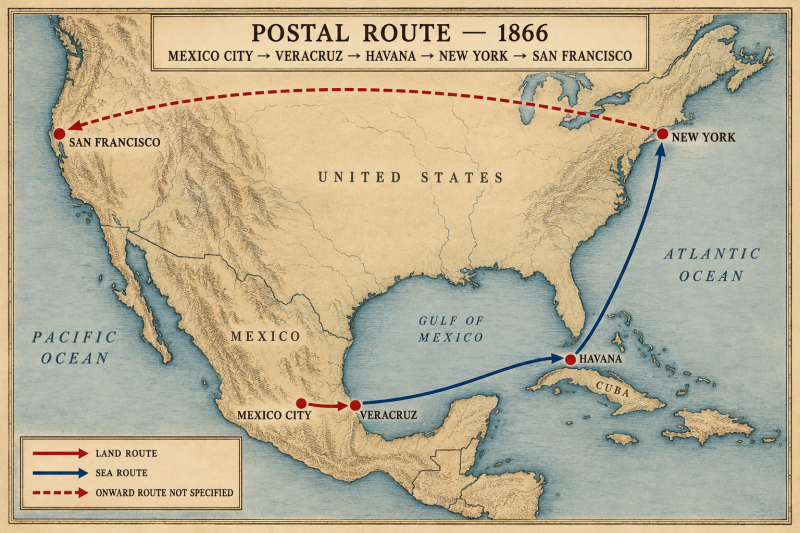
MEXICO → SAN FRANCISCO (via New York), 1 May 1866
Double-weight cover illustrating the Imperial Port Fee and the use of the Mexico–American Shipping Line.
This remarkable cover was mailed from Mexico City to San Francisco, California, on 1 May 1866. It is franked with a 2 reales orange and a ½ real (7 centavos) from the Imperial Eagle issue, for a total postage of 2½ reales.
Although no manuscript instruction requests transport by the Mexico-American Shipping Line, the presence of the ½ real Port Fee clearly indicates that the sender selected this service. Established by Imperial Decree of 18 July 1865, the line linked Veracruz, Havana, and New York, providing a regular Atlantic connection.
The 2 reales paid the inland postage from Mexico City to Veracruz, while the ½ real paid the Port Fee, covering the transfer of the letter from the Veracruz General Post Office directly to the waiting steamship.
After arriving in New York, the letter continued across the United States to San Francisco. The circular "N.Y. STEAMSHIP / 10" handstamp records the amount due for the maritime transport and the domestic U.S. service. However, the San Francisco post office charged double that amount, as indicated by the manuscript marking, because the cover was treated as double-weight rather than single-weight.
This cover is an outstanding illustration of the Imperial Port Fee and demonstrates the complexity of postal accounting between Mexico and the United States during the final months of the Second Mexican Empire.
JEAN-CLAUDE PORIGNON COLLECTION
MEXICO → SAN FRANCISCO (via New York), 1er mai 1866 (Ve période)
Lettre au double poids illustrant la taxe portuaire impériale et l'utilisation de la Mexico-American Shipping Line.
Cette remarquable lettre fut expédiée de Mexico à destination de San Francisco (Californie) le 1er mai 1866. Elle est affranchie d'un 2 reales orange et d'un ½ real (7 centavos) de l'émission des Aigles impériaux, pour un affranchissement total de 2½ reales.
Aucune mention manuscrite ne précise la compagnie maritime souhaitée. Toutefois, la présence du ½ real de taxe portuaire démontre que l'expéditeur demanda un acheminement par la Mexico-American Shipping Line. Créée par le décret impérial du 18 juillet 1865, cette ligne reliait Veracruz, La Havane et New York, offrant une liaison régulière avec les États-Unis.
Le 2 reales acquitte le transport intérieur entre Mexico et Veracruz, tandis que le ½ real correspond au paiement de la taxe portuaire, destinée au transfert du courrier entre le bureau principal de Veracruz et le paquebot prêt à appareiller.
Après son arrivée à New York, la lettre poursuivit son voyage jusqu'à San Francisco. La marque circulaire « N.Y. STEAMSHIP / 10 » indique la taxe due pour le transport maritime et la distribution aux États-Unis. Le bureau de San Francisco réclama cependant le double de cette somme, comme l'indique la taxe manuscrite, la lettre ayant été considérée comme un pli au double poids.
Cette pièce constitue un remarquable témoignage de l'application de la taxe portuaire impériale et illustre la complexité des échanges postaux entre le Mexique et les États-Unis durant les derniers mois du Second Empire mexicain.
JEAN-CLAUDE PORIGNON COLLECTION

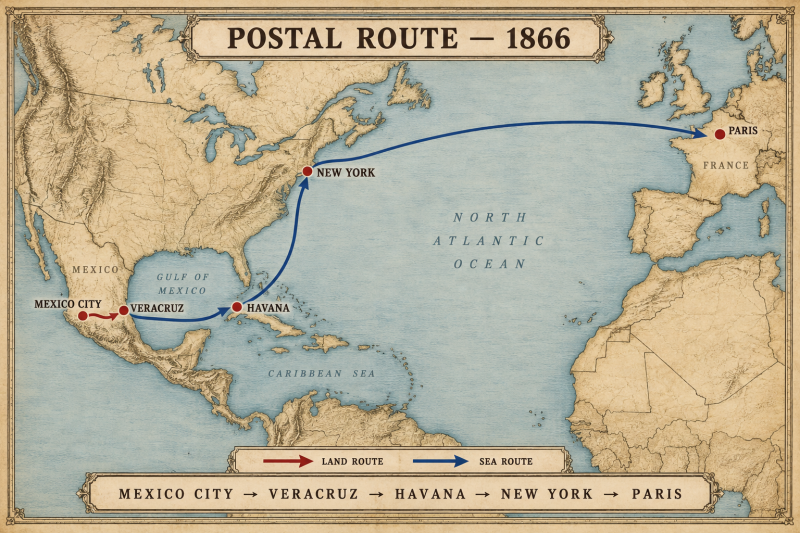
MEXICO → PARIS (FRANCE), 2 February 1866
Entire commercial cover sent from Mexico City to Paris via New York, franked with a 4 reales and a ½ real of the Imperial Eagle issue (consignment 19-1866). Both stamps are cancelled by the double-ring MEXICO datestamp.
Following the Imperial Decree of 18 July 1865, this double-weight letter illustrates the application of the new Port Fee, a charge of 7 centavos collected at Veracruz for overseas mail carried by the Mexico–American Shipping Line. The route via New York is confirmed by the red transit marking dated 6 March 1866, while the black "20" handstamp indicates the United States transit postage.
Upon arrival in France, the letter was taxed 24 décimes, corresponding to a commercial letter of triple French weight. Combining a rare double-weight franking, the Port Fee regulations, the American transit route and the French taxation system, this cover is an outstanding illustration of international postal rates during the final months of the Second Mexican Empire.
Source : J.C PORIGNON collection
MEXICO → PARIS (FRANCE), 2 février 1866
Lettre commerciale entière expédiée de Mexico à Paris par la voie de New York, affranchie d'un 4 reales et d'un ½ real de l'émission des Aigles impériaux (consignation 19-1866). Les deux timbres sont oblitérés par le cachet à double cercle MEXICO.
À la suite du décret impérial du 18 juillet 1865, cette lettre de double poids illustre l'application du nouveau Port Fee, taxe de 7 centavos perçue à Veracruz sur le courrier transporté par la ligne maritime Mexico–États-Unis. Le transit par New York est attesté par le cachet rouge du 6 mars 1866, tandis que la marque noire « 20 » correspond à la taxe de transit américaine.
À son arrivée en France, la lettre est taxée 24 décimes, correspondant au tarif d'une lettre commerciale du troisième échelon de poids français. Réunissant un affranchissement de double poids, l'application du Port Fee, un acheminement par les États-Unis et la taxation française, cette pièce constitue un remarquable témoignage des relations postales internationales durant les derniers mois du Second Empire mexicain.
Source : J.C PORIGNON collection

PLAN DE BARRANCAS (Tepic District) → GUADALAJARA, 9 May 1866
Strip of six ½ real brown – Fifth Period – Tepic District Sub-office
Entire commercial letter mailed from the sub-office of Plan de Barrancas, Tepic District, to Guadalajara on 9 May 1866, franked with a magnificent strip of six ½ real brown stamps of the Imperial Eagle issue, Fifth Period.
The stamps are tied by three clear strikes of the distinctive oval PLAN DE BARRANCAS – TEPIC cancellation, while an additional datestamp is applied on the cover. This attractive franking pays a total of 3 reales, illustrating an uncommon multiple use of the lowest denomination of the Imperial Eagle series.
Beyond its spectacular appearance, the cover is particularly significant because it originates from the rural sub-office of Plan de Barrancas, one of the secondary post offices operating within the Tepic District during the final months of the Imperial postal administration. Covers from these sub-offices are considerably scarcer than those from the principal district offices and provide valuable evidence of the organisation of the Mexican postal network under the Second Empire.
The combination of a complete commercial cover, a remarkable strip of six ½ real stamps and a clearly identifiable sub-office cancellation makes this an outstanding example of Imperial Eagle postal history.
Source: Jean-Claude Polignon Collection.
PLAN DE BARRANCAS (district de Tepic) → GUADALAJARA, 9 mai 1866
Bande de six timbres de ½ real brun – Ve période – Sous-bureau du district de Tepic
Lettre commerciale entière expédiée du sous-bureau de Plan de Barrancas, district de Tepic, à destination de Guadalajara le 9 mai 1866, affranchie d'une remarquable bande de six timbres de ½ real brun de l'émission des Aigles impériaux, Ve période.
Les timbres sont oblitérés par trois frappes bien nettes du cachet ovale PLAN DE BARRANCAS – TEPIC, tandis qu'une quatrième frappe datée est apposée sur la lettre. Cet affranchissement représente un total de 3 reales et illustre un usage peu commun en affranchissement multiple de la plus faible valeur faciale de la série.
Au-delà de son esthétique remarquable, cette pièce présente un intérêt historique majeur, car elle provient du sous-bureau de Plan de Barrancas, l'un des bureaux secondaires du district de Tepic durant les derniers mois de l'administration postale impériale. Les lettres issues de ces sous-bureaux sont nettement plus rares que celles des bureaux principaux et constituent de précieux témoignages de l'organisation du réseau postal mexicain sous le Second Empire.
L'association d'une lettre commerciale complète, d'une spectaculaire bande de six timbres de ½ real et d'une oblitération parfaitement identifiable du sous-bureau de Plan de Barrancas fait de cette pièce un remarquable témoignage de l'histoire postale des Aigles impériaux.
Source : Collection Jean-Claude Polignon.
THE CHIHUAHUA PARADOX
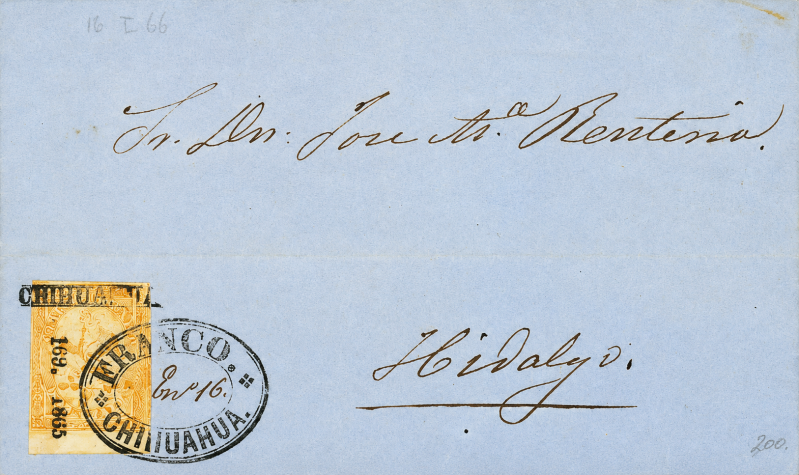
Chihuahua → Hidalgo, 16 January 1866
During much of 1865 and 1866, the State of Chihuahua remained under the control of Benito Juárez's Republican forces. Imperial postal authority was therefore severely restricted, making genuine postal usages of the Imperial Eagle issue from this district exceptionally scarce.
This cover, sent from Chihuahua to Hidalgo on 16 January 1866, is franked with a 2 reales yellow, Consignment 169-1865, bearing the CHIHUAHUA district overprint and cancelled at the Chihuahua post office.
According to the Karl H. Pietsch census, only two covers bearing a postally used 2 reales Chihuahua overprint are recorded.
LE PARADOXE DE CHIHUAHUA
Chihuahua → Hidalgo, 16 janvier 1866
Durant une grande partie de 1865 et 1866, l'État de Chihuahua demeura sous le contrôle des forces républicaines de Benito Juárez. L'administration postale impériale n'y exerçait qu'une autorité limitée, rendant particulièrement rares les utilisations postales authentiques des Aigles impériaux provenant de ce district.
Cette lettre, expédiée de Chihuahua à Hidalgo le 16 janvier 1866, est affranchie d'un 2 reales jaune, consignation 169-1865, portant la surcharge CHIHUAHUA et oblitéré par le cachet du bureau de Chihuahua.
Selon le recensement de Karl H. Pietsch, seules deux lettres portant un 2 reales surchargé Chihuahua utilisé sur courrier sont connues.

QUERÉTARO TO MEXICO CITY – 1866
Cover sent from Querétaro to Mexico City on June 8, 1866, franked with a spectacular strip of four 4½ reales lilac Imperial Eagles, for a total postage of 18 reales. The stamps belong to the Querétaro district, consignment 129-1865, Fifth Period.
The cover travelled approximately 57 leagues (238 km) and bears the CORREOS MEXICO arrival postmark on the reverse. A remarkable example of a high-rate multiple franking with the 4½ reales Imperial Eagle denomination.
From the collection of Rafael Aguilar Rico.
QUERÉTARO À MEXICO – 1866
Lettre expédiée de Querétaro à Mexico le 8 juin 1866, affranchie d’une spectaculaire bande de quatre Aigles impériaux de 4½ reales lilas, soit un affranchissement total de 18 reales. Les timbres appartiennent au district de Querétaro, envoi 129-1865, cinquième période.
La lettre a parcouru environ 57 lieues (238 km) et porte au verso le cachet d’arrivée CORREOS MEXICO.Un remarquable exemple d’affranchissement multiple de tarif élevé utilisant le timbre Aigle impérial de 4½ reales.
Collection Rafael Aguilar Rico.
THE CHIHUAHUA PARADOX (II)
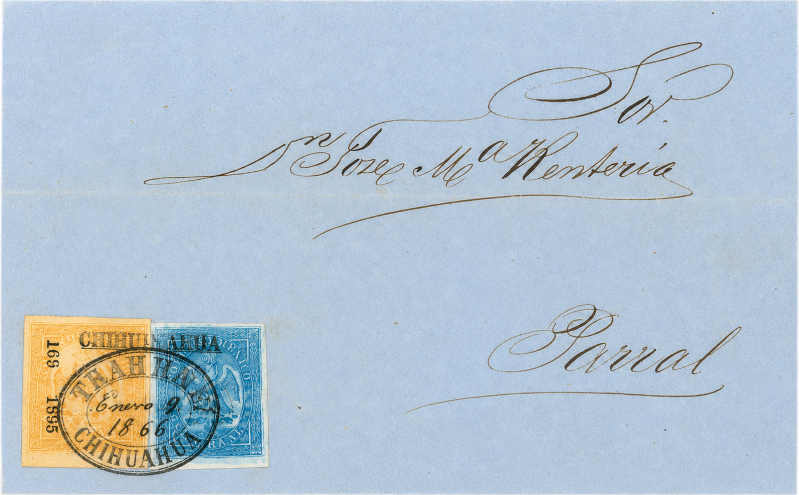
The Rarest Recorded Combination from the Chihuahua District
Chihuahua → Parral, 9 January 1866 (Fifth Period)
This remarkable cover complements the previous exhibit by illustrating an even rarer postal usage from the Chihuahua District.
It is franked with a 1 real blue and a 2 reales yellow, both Fifth Period (consignment 169-1865), bearing the Chihuahua district overprint, cancelled at Chihuahua on 9 January 1866 and addressed to Parral.
According to the Karl H. Pietsch census, only one cover bearing a used 1 real Chihuahua overprint has been recorded, while only two covers are known bearing a used 2 reales Chihuahua overprint.
The combination of these two exceptionally rare denominations on the same cover makes this one of the finest surviving postal items from the Chihuahua District.
Documentary source: Spink, Sale 24033, Lot 139 (2024).
LE PARADOXE DU CHIHUAHUA (II)
La combinaison la plus rare du district de Chihuahua
Chihuahua → Parral, 9 janvier 1866 (Ve période)
Cette remarquable lettre complète la pièce précédente en illustrant une utilisation postale encore plus exceptionnelle du district de Chihuahua.
Elle est affranchie d'un 1 real bleu et d'un 2 reales jaune, tous deux de la Ve période (consignation 169-1865), portant la surcharge du district de Chihuahua, oblitérés à Chihuahua le 9 janvier 1866, et adressés à Parral.
Selon le recensement établi par Karl H. Pietsch, une seule lettre affranchie d'un 1 real surchargé Chihuahua est actuellement connue, tandis que deux lettres seulement sont recensées avec un 2 reales surchargé Chihuahua.
La réunion de ces deux valeurs d'une extrême rareté sur un même courrier fait de cette pièce l'un des plus remarquables témoignages de l'histoire postale du district de Chihuahua.
Source documentaire : Spink, vente 24033, lot 139 (2024).

SAN LUIS POTOSÍ → ZACATECAS
6 August 1866 – Fifth Period
An Exceptional Fifth Period 8 Reales Usage
Mailed from San Luis Potosí to Zacatecas on 6 August 1866, this folded letter is franked with an 8 reales red in combination with a horizontal pair of the 1 real blue, all from Consignment 124-1866. The stamps are tied by the circular "S. LUIS POTOSÍ / AGO 6 1866" datestamp. This cover is of particular importance. According to research published by Schuyler J. Rumsey Philatelic Auctions, Consignment 124-1866 sent to the San Luis Potosí district originally contained no 8 reales stamps. The presence of this denomination on the cover therefore suggests that one or more 8 reales stamps were supplied later to replace stamps that had been lost or damaged.
Beyond its impressive 10 reales franking, this cover provides valuable evidence of the management of postal stamp supplies during the final months of the Second Mexican Empire. The cover is illustrated in Karl H. Pietsch, The Imperial Eagles of Mexico 1864–1866 (page 339).
Documentary Source
Schuyler J. Rumsey Philatelic Auctions
Sale 75 – Lot 2330
SAN LUIS POTOSÍ → ZACATECAS
6 août 1866 – Cinquième période
Un usage exceptionnel du 8 reales en cinquième période
Expédiée de San Luis Potosí à destination de Zacatecas le 6 août 1866, cette lettre est affranchie d'un 8 reales rouge, associé à une paire horizontale du 1 real bleu, tous deux issus de l'envoi 124-1866. Les timbres sont oblitérés par le cachet circulaire « S. LUIS POTOSÍ / AGO 6 1866 ».
Cette pièce présente un intérêt tout particulier. Selon les recherches publiées par Rumsey Philatelic Auctions, l'envoi n° 124-1866 destiné au district de San Luis Potosí ne comprenait initialement aucun timbre de 8 reales. La présence de cette valeur sur cette lettre laisse donc supposer qu'un ou plusieurs exemplaires furent expédiés ultérieurement afin de remplacer des timbres perdus ou détériorés. Au-delà de son remarquable affranchissement de 10 reales, cette lettre constitue un précieux témoignage de la gestion des approvisionnements postaux durant les derniers mois du Second Empire mexicain.
Cette pièce est illustrée dans l'ouvrage de Karl H. Pietsch, The Imperial Eagles of Mexico 1864–1866 (page 339).
Provenance documentaire
Schuyler J. Rumsey Philatelic Auctions
Sale 75 – Lot 2330

THE PARRAL OVERPRINT
One of the Rarest Sub-office Overprints of the Imperial Eagle Issue
Parral → Durango, 16 March 1866 (Fifth Period)
Like the Chihuahua main post office, the Parral sub-office applied its own district overprint to the Imperial Eagle stamps placed in use during the final months of the Empire. The cover presented here is franked with a 2 reales yellow, Fifth Period (consignment 169-1865) bearing the Parral overprint, cancelled at Parral on 16 March 1866, and addressed to Durango.
According to the Karl H. Pietsch census, only six used singles and five covers bearing the 2 reales Parral overprint have been recorded. This cover illustrates the exceptional rarity of postal material from one of the Imperial post offices that continued operating despite the political and military instability prevailing in northern Mexico.
Documentary source: Spink, Sale 24033, Lot 141 (2024).
LA SURCHARGE DE PARRAL
L'une des plus rares surcharges de sous-bureau de l'émission des Aigles impériaux
Parral → Durango, 16 mars 1866 (Ve période)
À l'image du bureau principal de Chihuahua, le sous-bureau de Parral appliqua sa propre surcharge sur les timbres des Aigles impériaux utilisés durant les derniers mois du Second Empire. La lettre présentée ici est affranchie d'un 2 reales jaune de la Ve période (consignation 169-1865) portant la surcharge de Parral, oblitéré à Parral le 16 mars 1866, et adressé à Durango.
Selon le recensement établi par Karl H. Pietsch, seuls six timbres détachés oblitérés et cinq lettres affranchies d'un 2 reales surchargé Parral sont actuellement recensés. Cette pièce illustre l'extrême rareté des documents postaux provenant de l'un des sous-bureaux impériaux qui continuèrent à fonctionner malgré les difficultés politiques et militaires du nord du Mexique.
Source documentaire : Spink, vente 24033, lot 141 (2024)

ZACATECAS → TLALTONALGO, 1866
½ real gray – Fifth Period – Printed Circular Rate
Printed circular mailed from Zacatecas to Tlaltonalgo, franked with a ½ real gray of the Imperial Eagle issue, Fifth Period (Consignment 5-1866). The stamp is cancelled by the ZACATECAS circular datestamp and correctly pays the printed matter rate.
This cover is one of the great rarities of the Fifth Period. According to David Pietsch, the majority of the stamps from this consignment were returned unused to Mexico City, leaving very few genuinely postally used examples.
To date, only one used example from Zacatecas is recorded, making this printed circular an exceptional rarity of the Imperial Eagle issue. Beyond its rarity, it provides valuable evidence of the use of the ½ real denomination for printed matter, a postal rate seldom represented in surviving covers.
Accompanied by a 2024 MEPSI certificate.
Source: Spink, Sale 24033, Lot 199.
ZACATECAS → TLALTONALGO, 1866
½ real gris – Ve période – Tarif des imprimés
Imprimé commercial expédié de Zacatecas à Tlaltonalgo, affranchi d'un ½ real gris de l'émission des Aigles impériaux, Ve période (consignation 5-1866). Le timbre est oblitéré par le cachet circulaire de Zacatecas et acquitte correctement le tarif des imprimés.
Cette pièce figure parmi les plus grandes raretés de la Ve période. Selon David Pietsch, la majorité des timbres de cette consignation furent retournés inutilisés à Mexico, expliquant l'extrême rareté des exemplaires ayant réellement circulé.
À ce jour, un seul exemplaire oblitéré provenant de Zacatecas est connu, ce qui fait de cet imprimé une pièce exceptionnelle de l'émission des Aigles impériaux. Au-delà de sa rareté, il constitue un remarquable témoignage de l'utilisation du ½ real pour l'affranchissement des imprimés, un tarif très rarement représenté sur document.
Accompagné d'un certificat MEPSI (2024).
Source : Spink, vente 24033, lot 199.

MEXICO → VÖSLAU (AUSTRIA)
13 June 1866 – Fifth Period
A Letter to Maximilian's Homeland
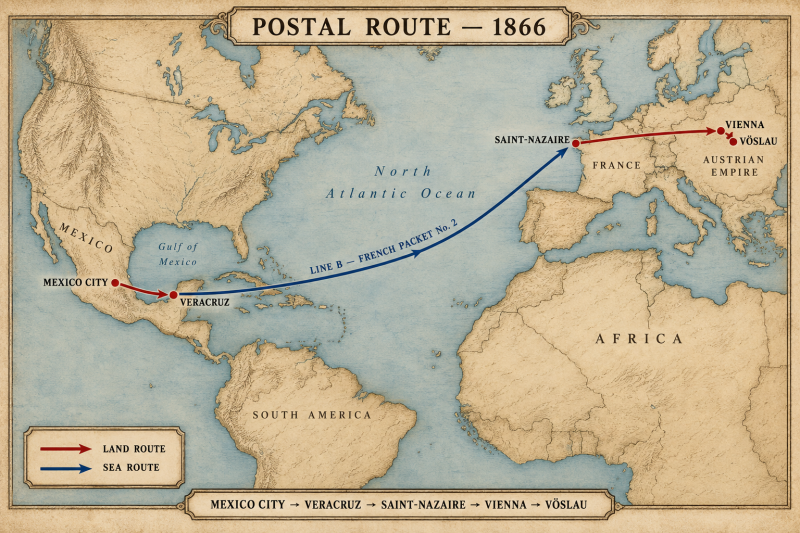
Mailed from Mexico City on 13 June 1866, this cover was addressed to Vöslau, near Vienna, in the Austrian Empire, the homeland of Emperor Maximilian of Habsburg.
It is franked with a 4 real green of the Imperial Eagle Issue, cancelled in Mexico City. This franking prepaid only the inland postage from Mexico City to Veracruz, while the international postage was collected from the recipient in accordance with the postal conventions then in force.
After reaching Veracruz, the letter was carried aboard a French mail steamer of Line B, which operated the transatlantic postal service between Mexico and Saint-Nazaire. Its passage is confirmed by the maritime postmark "LIGNE-B PAQ. FR. No. 2 / 14 JUIN 1866", struck aboard the vessel.
After landing in France, the cover continued overland across Europe, passing through Vienna (WIEN) before reaching its final destination at Vöslau. Because the postage was insufficient for a European destination, the recipient was charged 90 centimes, as indicated by the manuscript tax marking.
Beyond its postal significance, this cover has considerable historical importance. It was mailed only a few weeks before the collapse of the Second Mexican Empire and represents one of the last surviving postal links between Imperial Mexico and the homeland of Emperor Maximilian.
Postal Route
Mexico City → Veracruz → Line B (French Mail Steamer No. 2) → Saint-Nazaire → Vienna → Vöslau
Current Collection
Patrice Mollien Collection
Provenance
Ex Antonio Torres, London
MEXICO → VÖSLAU (AUTRICHE)
Un courrier vers la patrie de Maximilien
Contexte historique
Le 13 juin 1866, lorsque cette lettre quitte Mexico, le Second Empire mexicain vit ses derniers mois. Moins d'un an plus tard, le 19 juin 1867, l'empereur Maximilien sera fusillé à Querétaro. Cette lettre est ainsi l'un des ultimes témoins des relations postales entre le Mexique impérial et l'Autriche.
Expédiée de Mexico le 13 juin 1866, cette lettre est adressée à Vöslau, près de Vienne, au cœur de l'Empire d'Autriche, pays natal de l'empereur Maximilien de Habsbourg.
Elle est affranchie d'un 4 real vert de l'émission des Aigles impériaux, oblitéré à Mexico. Cet affranchissement ne couvrait que le port intérieur mexicain, la taxe internationale étant perçue à destination conformément aux conventions postales en vigueur.
Après avoir rejoint le port de Veracruz, la lettre fut embarquée sur un paquebot français de la Ligne B assurant la liaison entre le Mexique et Saint-Nazaire. Son passage est attesté par le cachet maritime « LIGNE-B PAQ. FR. No 2 / 14 JUIN 1866 », appliqué à bord du navire.
Débarquée en France, elle poursuivit son voyage par voie terrestre à travers l'Europe, transitant par Vienne (WIEN) avant d'être distribuée à Vöslau. Son insuffisance d'affranchissement entraîna la perception, à l'arrivée, d'une taxe manuscrite de 90 centimes.
Au-delà de son intérêt postal, cette lettre revêt une forte dimension historique. Elle fut expédiée quelques semaines seulement avant l'effondrement du Second Empire mexicain. Elle constitue ainsi l'un des derniers témoignages des échanges postaux entre le Mexique impérial et la terre natale de l'empereur Maximilien.
Itinéraire postal
Mexico → Veracruz → Ligne B (Paquebot français n°2) → Saint-Nazaire → Vienne → Vöslau
Collection actuelle
Patrice Mollien
Provenance
Ex Antonio Torres, London

MORELIA → MEXICO CITY
3 January 1866 • Fifth Period
One of the Greatest Rarities of the Imperial Eagle Issue
This registered cover front was mailed from Morelia to Mexico City on 3 January 1866 and is franked with an 8 reales red of the Imperial Eagle Issue, from Consignment No. 77-1865.
The stamp is tied by the circular "MORELIA / 3 ENERO 1866" datestamp. The boxed "CERTIFICADO EN MORELIA" handstamp confirms that the item was sent by registered mail, a postal service seldom encountered during the Imperial period.
Postal records indicate that only 317 examples of the 8 reales from this consignment were supplied to the Morelia district. Current research records only two registered covers bearing this consignment number, both mailed from Morelia in January 1866. This example is regarded as the finer of the two.
Formerly part of the prestigious O. Rodríguez Collection, this remarkable cover ranks among the major rarities of the Imperial Eagle Issue of Mexico.
Documentary Source
Schuyler J. Rumsey Philatelic Auctions
Sale 73 – Lot 2747
MORELIA → MEXICO
3 janvier 1866 • Cinquième période
L'une des plus grandes raretés de l'émission des Aigles impériaux
Cette lettre recommandée, expédiée de Morelia à destination de Mexico le 3 janvier 1866, est affranchie d'un 8 reales rouge de l'émission des Aigles impériaux, provenant de la consignation n° 77-1865.
Le timbre est oblitéré par le cachet circulaire « MORELIA / 3 ENERO 1866 ». La griffe encadrée « CERTIFICADO EN MORELIA » atteste que l'envoi a circulé en courrier recommandé, un service particulièrement peu fréquent durant la période impériale.
Selon les archives postales, 317 exemplaires seulement du 8 reales de cette consignation furent expédiés au district de Morelia. Les recherches actuelles ne recensent que deux lettres recommandées portant ce numéro de consignation, toutes deux expédiées de Morelia en janvier 1866. Cet exemplaire est considéré comme le plus beau des deux.
Illustrée dans les principales études consacrées aux Aigles impériaux et provenant de la prestigieuse collection O. Rodríguez, cette pièce figure parmi les plus grandes raretés connues de cette émission.
Source documentaire
Schuyler J. Rumsey Philatelic Auctions
Sale 73 – Lot 2747

CORDOVA → BALTIMORE (UNITED STATES)
A Rare Imperial Eagle Cover to the United States
This cover was mailed from Cordova to Baltimore, Maryland, during the final months of the Second Mexican Empire. It is franked with a ½ real lilac (Type IV) and a 2 reales orange (Type V) of the Imperial Eagle Issue, from Consignments 189-1865 and 41-1866 respectively.
The stamps are cancelled by the scarce boxed "CORDOVA FRANCO" handstamp (Schatzkes 188). The manuscript endorsement "Via New York Steamer" indicates that the cover travelled by steamship to New York before continuing to Baltimore. Its transit through the United States is confirmed by the "N.Y. Steamship – May 18" datestamp.
Imperial Eagle covers addressed to the United States are seldom encountered. This example illustrates the international postal connections linking Mexico and the United States during the final year of Emperor Maximilian's reign.
The reverse of the cover preserves part of the original correspondence, including a handwritten note requesting that the recipient's mail be forwarded as quickly as possible—an appealing personal detail that adds to its historical interest.
Documentary Source
Schuyler J. Rumsey Philatelic Auctions
Sale 75 Lot 2376
CORDOVA → BALTIMORE (ÉTATS-UNIS)
Une rare lettre des Aigles impériaux à destination des États-Unis
Cette lettre fut expédiée de Cordova à destination de Baltimore (Maryland) durant les derniers mois du Second Empire mexicain. Elle est affranchie d'un ½ real lilas (Type IV) et d'un 2 reales orange (Type V) de l'émission des Aigles impériaux, provenant respectivement des consignations 189-1865 et 41-1866.
Les timbres sont oblitérés par le rare cachet encadré « CORDOVA FRANCO » (Schatzkes 188). La mention manuscrite « Via New York Steamer » indique un transport par paquebot jusqu'à New York, avant la poursuite du voyage vers Baltimore. Le passage aux États-Unis est confirmé par le cachet « N.Y. Steamship – 18 mai ».
Les lettres des Aigles impériaux à destination des États-Unis sont particulièrement peu communes. Cette pièce illustre les relations postales internationales entre le Mexique impérial et les États-Unis au cours de la dernière année du règne de Maximilien.
Le verso conserve une partie de la correspondance d'origine, comprenant une annotation manuscrite demandant que le courrier soit transmis au destinataire le plus rapidement possible, détail qui renforce encore l'intérêt historique de cette lettre.
Source documentaire
Schuyler J. Rumsey Philatelic Auctions
Sale 75 Lot 2376

MEXICO → HAVANA (CUBA), 1866
Imperial Eagle Letter Carried by the British Packet "Indias"
This remarkable folded letter, mailed from Mexico City to Havana, Cuba, bears two 2 reales orange Imperial Eagle stamps from the Fifth Period (Consignment 110-1866), both paying the inland Mexican postage to Veracruz.
The cover is particularly significant because it illustrates the cooperation between the Mexican Imperial Post and the British Packet Agency. One stamp is cancelled by the Mexico City circular datestamp, while the second received the distinctive cancellation of the British Packet Agency, marking the transfer of the letter from the Mexican postal system to the British maritime mail service.
From Veracruz, the letter was carried directly to Havana aboard the British packet "Indias", one of the Royal Mail steamers operating between Mexico and the Caribbean. Upon arrival in Cuba, a 1 shilling due marking was applied in accordance with the postal conventions governing correspondence transported through the British packet service.
Beyond its attractive double franking, this cover provides an outstanding illustration of the complex international postal routes linking Mexico, Great Britain and Spanish Cuba during the final months of Emperor Maximilian's reign.
A superb exhibition piece combining postal history, maritime communications and international postal conventions.
Source: Schuyler J. Rumsey Philatelic Auctions – Sale 120, Lot 3377.
MEXICO → HAVANA (CUBA), 1866
Une lettre des Aigles impériaux transportée par le paquebot britannique « Indias »
Cette remarquable lettre repliée, expédiée de Mexico à destination de La Havane (Cuba), est affranchie de deux timbres de 2 reales orange de la Cinquième période (envoi 110-1866), acquittant le port intérieur mexicain jusqu'à Veracruz.
Cette pièce illustre parfaitement la coopération entre la Poste Impériale mexicaine et l'Agence des paquebots britanniques. L'un des timbres est oblitéré par le cachet circulaire de Mexico, tandis que le second reçoit le cachet de l'Agence britannique, matérialisant le transfert de la correspondance entre le réseau postal mexicain et le service maritime britannique.
Depuis Veracruz, la lettre fut transportée directement jusqu'à La Havane à bord du paquebot britannique « Indias », l'un des navires de la Royal Mail assurant les liaisons postales entre le Mexique et les Antilles. À son arrivée à Cuba, une taxe de 1 shilling fut appliquée conformément aux conventions postales régissant les correspondances acheminées par les paquebots britanniques.
Au-delà de son élégant double affranchissement, cette lettre constitue un remarquable témoignage des relations postales internationales entre le Mexique, la Grande-Bretagne et Cuba espagnole, à une époque où les réseaux postaux impériaux et maritimes étaient étroitement imbriqués.
Une superbe pièce d'exposition illustrant les communications maritimes internationales durant les derniers mois du Second Empire mexicain.
Source : Schuyler J. Rumsey Philatelic Auctions – Sale 120, lot 3377.

JALAPA TO MEXICO CITY – 1866
Remarkable cover from the Jalapa postal district to Mexico City, franked with a 1 real blue Imperial Eagle and three 2 reales yellow-orange Imperial Eagles, for a total postage of 7 reales.
The franking combines stamps from two different consignments of the Fifth Period: the 1 real blue bears consignment 8-1866, sub-consignment 6-1866, while the three 2 reales bear consignment 69-1866, sub-consignment 9-1866.
All four stamps show the JALAPA district overprint and are tied to the cover by circular postal cancellations.
This spectacular combination is particularly interesting for the study of the Imperial Eagle issue, as it illustrates the simultaneous postal use of stamps from two different consignments and sub-consignments on the same cover.
Piece illustrated from an Ebay listing.
JALAPA À MEXICO – 1866
Remarquable lettre du district postal de Jalapa à destination de Mexico, affranchie d’un Aigle impérial de 1 real bleu et de trois Aigles de 2 reales jaune-orange, soit un affranchissement total de 7 reales.
L’affranchissement réunit des timbres provenant de deux envois différents de la cinquième période : le 1 real bleu porte l’envoi 8-1866, sous-envoi 6-1866, tandis que les trois 2 reales portent l’envoi 69-1866, sous-envoi 9-1866.
Les quatre timbres portent la surcharge de district JALAPA et sont oblitérés sur la lettre par des cachets postaux circulaires.
Cette spectaculaire combinaison présente un intérêt particulier pour l’étude des Aigles impériaux, puisqu’elle illustre l’utilisation simultanée sur une même lettre de timbres provenant de deux envois et sous-envois différents.
Pièce illustrée provenant d’une vente eBay.
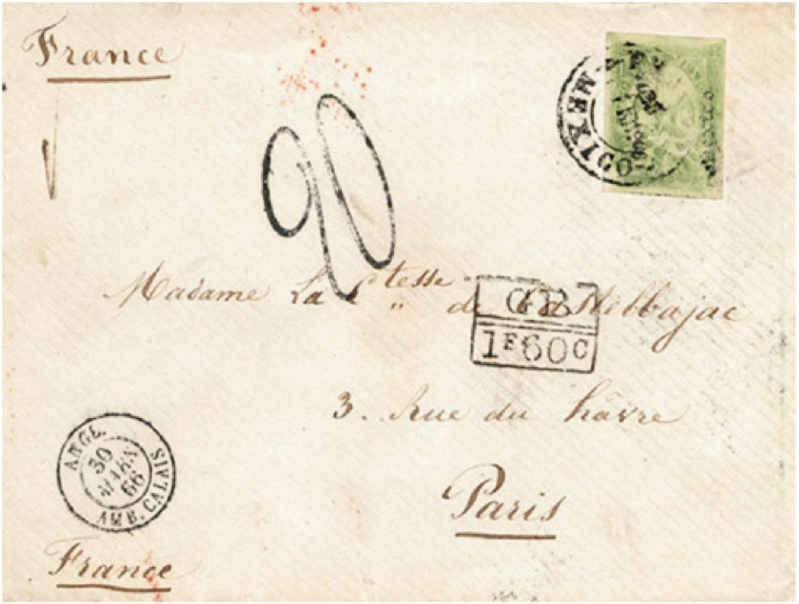
MEXICO TO PARIS – ANGLO-FRENCH MARITIME MAIL, 1866
A remarkable Imperial Eagle cover sent from Mexico City to Paris on February 25, 1866, providing a particularly fine illustration of the complex Anglo-French maritime postal route between Mexico and Europe during the Second Mexican Empire.
The cover is franked with a 4 reales light-green Imperial Eagle, bearing consignment 40-1866 of the Mexico district. The letter weighed approximately ¾ ounce, and the 4 reales postage covered the Mexican inland rate for a letter travelling more than 17 leagues. From Mexico City to the port of Veracruz, it travelled approximately 93 leagues (389 km) before entering the transatlantic mail system.
The Eagle is cancelled by the circular FRANCO / MEXICO postmark. From Veracruz, the letter was forwarded by British maritime mail, beginning an unusually well-documented journey that can be reconstructed from the postal markings:
Mexico → Veracruz → British maritime service → London → Calais → Paris.
One of the most significant markings is the boxed GB / 1F60C accounting handstamp. The 1 franc 60 centimes per 30 grams notation records the postal accounting associated with mail carried through the British service.
The cover transited London on March 10, 1866. On reaching France by British packet, it received the ANGL. AMB. CALAIS marking dated March 30, identifying mail entering the French postal system through Calais from the British service.
The large manuscript “20” on the front represents the 20 décimes charged by the French postal administration for an unpaid letter weighing 15 grams. The journey finally ended in Paris on April 4, 1866, approximately one month and ten days after its departure from Mexico.
This exceptional cover brings together a 4 reales Imperial Eagle, Mexican inland postage, British transatlantic carriage, Anglo-French postal accounting, transit through London and Calais, and French taxation upon arrival. It provides a particularly instructive example of the international postal mechanisms linking Imperial Mexico with Europe in 1866.
From the collection of Rafael Aguilar Rico.
MEXICO À PARIS – COURRIER MARITIME ANGLO-FRANÇAIS, 1866
Remarquable lettre des Aigles impériaux expédiée de Mexico à destination de Paris le 25 février 1866, illustrant de manière particulièrement complète la complexité des relations postales maritimes anglo-françaises entre le Mexique et l’Europe sous le Second Empire mexicain.
La lettre est affranchie d’un Aigle impérial de 4 reales vert clair, portant la consignation 40-1866 du district de Mexico. D’un poids d’environ ¾ d’once, elle acquitte par cet affranchissement le tarif intérieur mexicain applicable à une lettre parcourant plus de 17 lieues. Entre Mexico et le port de Veracruz, elle effectue ainsi un premier trajet d’environ 93 lieues, soit 389 km, avant d’intégrer le réseau postal transatlantique.
Le timbre est oblitéré par le cachet circulaire FRANCO / MEXICO. À partir de Veracruz, la lettre est confiée au service maritime britannique et commence un long voyage dont les différentes étapes peuvent être reconstituées grâce aux marques postales :
Mexico → Veracruz → service maritime britannique → Londres → Calais → Paris.
Parmi ces marques, le cachet comptable encadré GB / 1F60C présente un intérêt particulier. L’indication 1 franc 60 centimes par 30 grammes correspond à la comptabilité postale liée à l’acheminement du courrier par l’intermédiaire britannique.
La lettre transite par Londres le 10 mars 1866. Acheminée vers la France par paquebot britannique, elle reçoit ensuite à Calais, le 30 mars, le cachet ANGL. AMB. CALAIS, caractéristique du courrier entrant en France par la voie britannique.
Le grand « 20 » manuscrit porté au recto correspond aux 20 décimes réclamés par l’administration postale française pour cette lettre de 15 grammes non affranchie pour son parcours français.
Elle atteint finalement Paris le 4 avril 1866, soit environ un mois et dix jours après son départ de Mexico.
Cette pièce réunit ainsi sur un même pli un Aigle impérial de 4 reales, le tarif intérieur mexicain, un transport maritime britannique, la comptabilité postale anglo-française, les transits de Londres et de Calais ainsi que la taxation française à l’arrivée. Elle constitue un remarquable témoignage du fonctionnement du courrier international reliant le Mexique impérial à l’Europe en 1866.
Pièce provenant de la collection de Rafael Aguilar Rico.