Second Period (7 July – 19 September 1864)
The Second Period marks an important stage in the development of the Imperial Eagles issue. As the postal administration expanded throughout the Empire, the distribution and control of stamps became more organized.
During this period, district overprints and consignment numbers began to appear on the stamps. These markings were introduced to improve accounting procedures and to prevent fraud within the postal system. Stamps were distributed to district post offices in numbered consignments, allowing the Imperial administration to track their movement and usage.
The growing availability of stamps throughout the country also led to a wider variety of postal usages. Covers from principal post offices became more common, while mail originating from sub-offices remained scarcer and often presents particular philatelic interest.
The stamps, covers, and cancellations presented in this section illustrate the rapid expansion of the Imperial postal network during the summer of 1864, at a time when Maximilian's administration was attempting to strengthen its authority across the Mexican territory.
Deuxième période (7 juillet – 19 septembre 1864)
La deuxième période marque une étape importante dans l'évolution de l'émission des Aigles impériaux. À mesure que l'administration postale se développe à travers l'Empire, la distribution et le contrôle des timbres deviennent plus structurés.
C'est au cours de cette période que les surcharges de district et les numéros d'envoi commencent à apparaître. Ces marques sont introduites afin d'améliorer le contrôle comptable des timbres et de limiter les risques de fraude au sein de l'administration postale. Les timbres sont désormais expédiés aux différents districts dans des envois numérotés permettant de suivre leur distribution et leur utilisation.
L'extension progressive du réseau postal favorise également une plus grande diversité des usages. Les correspondances provenant des bureaux principaux deviennent plus fréquentes, tandis que celles issues des sous-bureaux demeurent plus rares et présentent souvent un intérêt philatélique particulier.
Les timbres, lettres et oblitérations présentés dans cette section illustrent l'expansion rapide du réseau postal impérial durant l'été 1864, alors que l'administration de Maximilien s'efforce de renforcer son contrôle sur l'ensemble du territoire mexicain.
Main Post Offices / bureaux principaux and sub-office / sous-bureaux


Period II – Consignment 185-1864
Front to Puebla franked with a 4 reales green bearing the Jalapa district overprint and consignment number 185-1864. The stamp is cancelled by the Jalapa administrative handstamp "4" (Schatzkès No. 606), an official administrative marking reused as a postal cancellation. This consignment included only 100 examples of the 4 reales denomination.
Période II – Consignation 185-1864
Devant de lettre pour Puebla affranchi d'un 4 reales vert portant la surcharge de district « Jalapa » et le numéro de consignation 185-1864. Le timbre est annulé par la surcharge administrative « 4 » de Jalapa (Schatzkès n°606), ancien cachet administratif réemployé comme oblitération postale. Cette consignation ne comprenait que 100 exemplaires de la valeur à 4 reales.
ORIZABA → GUADALAJARA, 1864
Complete cover from Orizaba to Guadalajara franked with a combination of the 2 reales yellow and 4 reales green Imperial Eagle stamps, paying a total postage of 6 reales.
This franking corresponds to the domestic rate for a heavy-weight letter exceeding one ounce and illustrates the strict application of the Imperial postal regulations based on weight. The use of the 4 reales denomination on cover is significantly less common than that of the lower values and is particularly desirable when found as part of a multiple-rate franking.
ORIZABA → GUADALAJARA, 1864
Lettre complète d'Orizaba à destination de Guadalajara, affranchie au moyen d'une combinaison des valeurs de 2 reales jaune et 4 reales vert de l'émission des Aigles impériaux, pour un port total de 6 reales.
Cet affranchissement correspond au tarif intérieur applicable à une lettre de poids élevé excédant une once et illustre l'application rigoureuse des règlements postaux du Second Empire mexicain fondés sur le poids des correspondances.


The ordinary inland letter rate was 2 reales for a letter weighing up to ½ ounce.
This cover from Vera Cruz to Mexico is franked at 8 reales, corresponding to a weight of 2 ounces, or four times the basic rate, in accordance with the postal rate progression then in force.
The franking consists of a single 8 reales red stamp bearing the overprint “Vera Cruz 152–1864”, illustrating a scarce usage of a heavy-weight inland rate within the territory of the Mexican Empire.
Accompanied by a MEPSI certificate.
Le tarif intérieur ordinaire des lettres simples était fixé à 2 real jusqu’à ½ once.
Cette lettre de Vera Cruz pour Mexico est affranchie à 8 real, correspondant à un poids de 2 onces, soit quatre fois le tarif de base, conformément à la progression postale en vigueur.
L’affranchissement, composé d’un timbre de 8 real rouge surchargé « Vera Cruz 152 –1864 », illustre un usage rare du tarif lourd à l’intérieur du territoire impérial.
Certificat MEPSI
Sub-office TLALPUJAHUA, Michoacán. 1864. Cover to Mexico franked with a 2 reales yellow Imperial Eagle stamp bearing the district overprint TLALPUJAHUA and consignment number 134-1864.
The stamp is cancelled by the FRANCA TLALPUJAHUA datestamp. This cover illustrates the administrative control system implemented under the Second Mexican Empire, whereby stamps were identified by consignment numbers assigned to each postal district. The mining town of Tlalpujahua in Michoacán is among the less commonly encountered districts on cover.
Sous-bureau TLALPUJAHUA, Michoacán. 1864. Lettre à destination de Mexico affranchie d'un 2 reales jaune de l'émission Aigle impérial, portant la surcharge de district TLALPUJAHUA et le numéro d'envoi 134-1864.
Le timbre est oblitéré par le cachet à date FRANCA TLALPUJAHUA. Cette lettre illustre le système de contrôle administratif mis en place sous le Second Empire mexicain, les timbres étant identifiés par un numéro d'envoi attribué à chaque district postal. Le bureau de Tlalpujahua, important centre minier du Michoacán, figure parmi les districts les moins fréquemment rencontrés sur lettre.
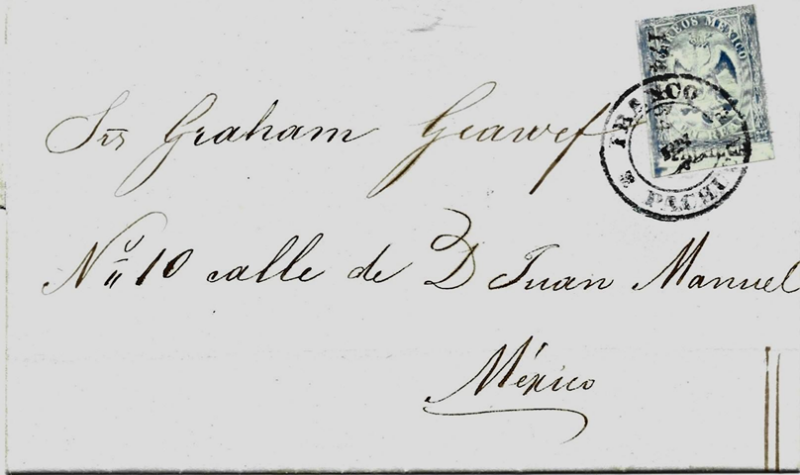

PACHUCA → MEXICO, 1864
Franked with a 1 real blue stamp bearing consignment number 124–1864. Letter paying the basic domestic postage rate. Circular datestamp of the standardized postal type introduced during the Second Imperial Period.
PACHUCA → MEXICO, 1864 Affranchissement à 1 real bleu, surcharge n° 124–1864. Lettreau tarif intérieur de base. Cachet circulaire normalisé de la seconde période impériale. en anglais
20 août 1864. Lettre de Yrapuato pour Guanajuato, affranchie d'un 1 real bleu surcharge 134-1864. Rare oblitération négative « Correos YRAPUATO ». La date manuscrite « Agosto 20 de 64 » permet de situer précisément ce pli dans la deuxième période de l'émission des Aigles impériaux. Certificat Pascal Scheller.
20 August 1864. Cover from Yrapuato to Guanajuato, franked with a 1 real blue bearing the district overprint 134-1864. Rare negative handstamp “CORREOS YRAPUATO”. The manuscript date “Agosto 20 de 64” allows this cover to be precisely assigned to the Second Period of the Imperial Eagles issue. Certificate by Pascal Scheller.